
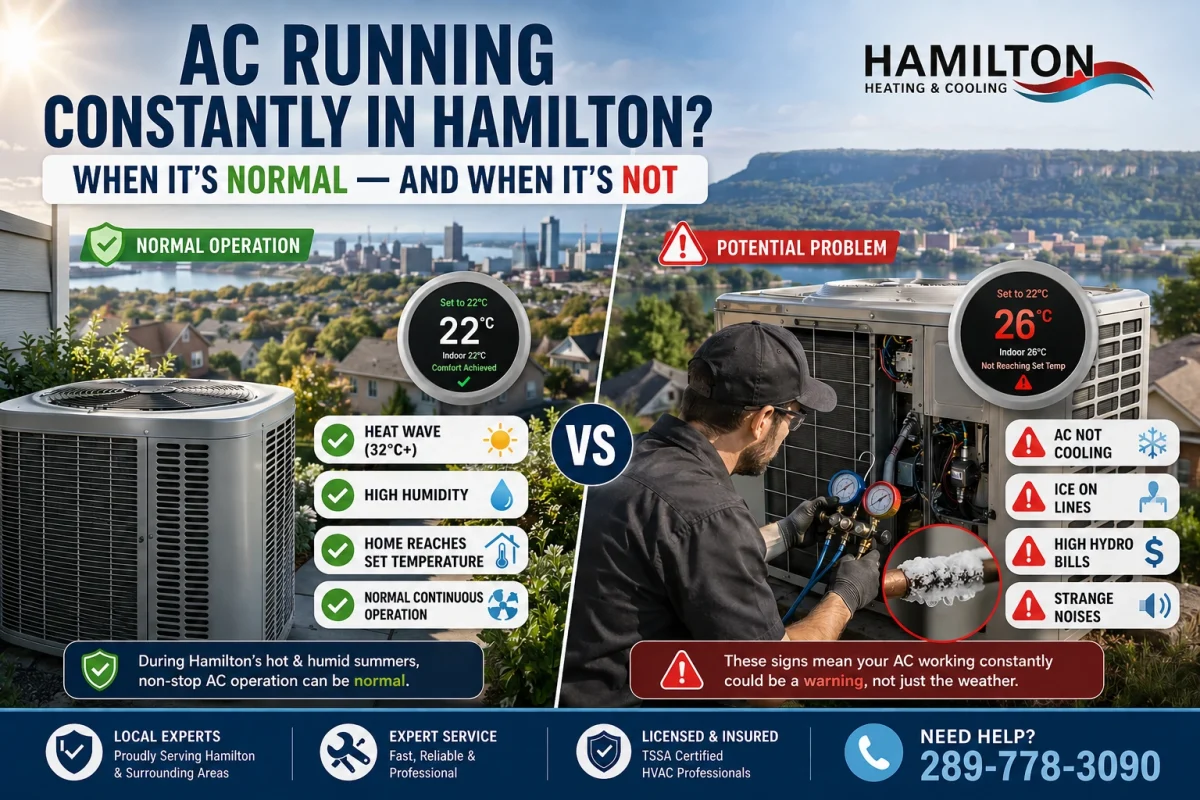
AC Running Constantly During a Hamilton Summer? Here’s When It’s Normal — and When It’s Not
If your AC is running constantly during a Hamilton summer, here’s the short answer: some of that is completely normal — and some of it is a quiet warning sign your system needs attention. This guide tells you exactly which is which, so you’re not left guessing in a 30°C house.
Hamilton’s climate adds a layer most generic guides ignore. Humidity regularly sits at 70–85% in July and August, and your air conditioner is fighting two battles at once: dropping the temperature and pulling moisture out of the air. That double load changes what “normal” runtime actually looks like here — and it’s why comparing your unit to a cousin’s AC in Calgary is a waste of time.
Whether you’re a first-time homeowner wondering if something is wrong, or a long-time Hamilton resident whose system seems to be working harder than it used to, this article gives you a clear, practical framework to diagnose the situation yourself before calling a technician.
❄️ Hamilton’s Trusted HVAC Experts
Is Your AC Working Too Hard This Summer?
Hamilton’s humidity makes AC problems worse — and harder to spot. Our certified technicians diagnose and fix the issue the same day, before a minor problem becomes an expensive failure.
When Is Your AC Running Constantly Actually Normal in Hamilton?
The traditional rule of thumb — that an AC should cycle on for 15–20 minutes, then off for 7–10 minutes — was designed for dry climates. In Hamilton’s humid summers, those numbers shift significantly. Here’s when non-stop running is expected behaviour, not a problem.
During Heat Waves Above 32°C
When the outdoor temperature exceeds 32°C, a correctly sized central AC system is designed to run almost continuously. It’s maintaining a 10–12°C difference between outside and inside air — that requires sustained effort. If your home is staying at or near your thermostat’s set temperature, the system is working exactly as engineered, even if it rarely shuts off.
On High-Humidity Days (Even When It’s Not Scorching)
Hamilton regularly sees days in the mid-to-high 20s with humidity above 75%. Your AC isn’t just cooling the air on those days — it’s actively dehumidifying it. The latent heat load (removing moisture) can rival or exceed the sensible heat load (dropping temperature), which means the compressor runs longer. If your indoor humidity is staying comfortable and the temperature is holding, prolonged runtime is doing its job.
During Late Afternoon Peak Heat Hours (2–6 PM)
Solar heat gain through south- and west-facing windows peaks between 2 and 6 PM. Even a well-insulated home with a properly sized system can see the AC run non-stop during this window. This is normal. If the system is cycling off by early evening as temperatures drop, you’re fine.
Is Your Air Conditioner Ready for Hamilton’s Next Heatwave?
quick questions to reveal your system’s failure risk and prevent costly breakdowns.
By submitting this form, you are giving your consent to receive phone calls and text messages from our contractor partners.
Reduce Your Energy Costs
A properly sized, high-efficiency AC keeps operating costs low. Get free quotes from certified contractors.
Get Free Quotes6 Warning Signs Your AC Running Constantly Is Actually a Problem
The single most important diagnostic question isn't "how long is it running?" — it's "is it reaching the set temperature?" If the answer is no, or if you're noticing the signs below, the AC running constantly has moved from normal to problematic.
1. It Runs All Day But Never Reaches Your Set Temperature
This is the clearest indicator of a problem. If your thermostat is set to 22°C and the house sits at 26°C by mid-afternoon despite continuous operation, something is impeding cooling capacity. The usual culprits: a dirty evaporator coil, low refrigerant, a failing capacitor, or a system that's simply undersized for your home.
2. Warm or Lukewarm Air from the Vents
Hold your hand over a supply vent when the system is running. You should feel noticeably cool air — typically 10–12°C cooler than your room temperature. If the air feels just slightly cool or even neutral, the refrigerant charge may be low, or the evaporator coil may be frozen (which paradoxically reduces cooling output despite the system running constantly).
3. Ice on the Refrigerant Lines or Indoor Unit
Ice anywhere on your AC — on the copper lines near the indoor unit, or on the evaporator coil itself — is a sign the system needs to be shut down and inspected. Frozen coils are usually caused by restricted airflow (a clogged filter is the first thing to check) or low refrigerant. Continuing to run a frozen system accelerates compressor wear and can turn a $150 repair into a $1,500 one.
4. Your Hydro Bill Spiked Sharply — Even Accounting for the Heat
An AC running constantly during a heat wave will cost more to operate — that's expected. But if your July or August bill is dramatically higher than the same period last year with similar weather, the system's efficiency has likely dropped. Dirty condenser coils, a failing capacitor, or low refrigerant all force the compressor to work harder for the same output, consuming significantly more electricity.
5. Unusual Sounds — Grinding, Hissing, Banging, or Clicking
A healthy AC is relatively quiet. New noises during a period of constant running deserve immediate attention. A hissing sound often indicates a refrigerant leak. Grinding or screeching usually points to a failing blower motor bearing. Clicking at startup or shutdown can be a failing relay or contactor — relatively inexpensive if caught early, but a precursor to a no-start failure if ignored.
6. Indoor Humidity Remains High Despite Constant Operation
If your home feels clammy or sticky even though the AC has been running all day, dehumidification performance has dropped. This can be caused by an oversized system that short-cycles (less common when it's running constantly), a refrigerant issue that shifts the operating pressures, or a duct leak that's pulling in unconditioned humid air from a crawlspace or attic. In Hamilton's humid climate, this symptom deserves a professional diagnosis.
What's Wrong With Your AC?
Experiencing AC problems? Follow our guided assessment to pinpoint the cause.
By submitting this form, you are giving your consent to receive phone calls and text messages from our contractor partners.
Get a Certified Tech to Confirm
Our diagnosis is a starting point. A certified HVAC technician can confirm the issue and fix it right the first time.
Get Free QuotesThe Most Common Causes of an AC Running Constantly in Hamilton Homes
Dirty Air Filter — The Most Overlooked Cause
A clogged air filter restricts airflow across the evaporator coil, dramatically reducing the system's ability to absorb heat. The compressor keeps running because the target temperature is never reached.
In Hamilton's pollen-heavy spring and dusty summer, filters in homes with pets or older ductwork can clog within 4–6 weeks. If you haven't changed your filter since last cooling season, start here — it takes five minutes and costs under $20.
For more on maximizing filter performance, see our guide on getting the most from your air filter in Hamilton.
Low Refrigerant (Freon / R-410A Charge)
AC systems are sealed — they don't "use up" refrigerant the way a car burns fuel. If yours is low, there's a leak. Low refrigerant reduces the system's heat-absorption capacity, forcing longer run times for less cooling.
It also causes suction line icing, elevated head pressure, and accelerated compressor wear. Refrigerant handling and recharging requires a licensed HVAC technician under Canadian regulations — this is not a DIY repair.
Dirty Condenser Coils on the Outdoor Unit
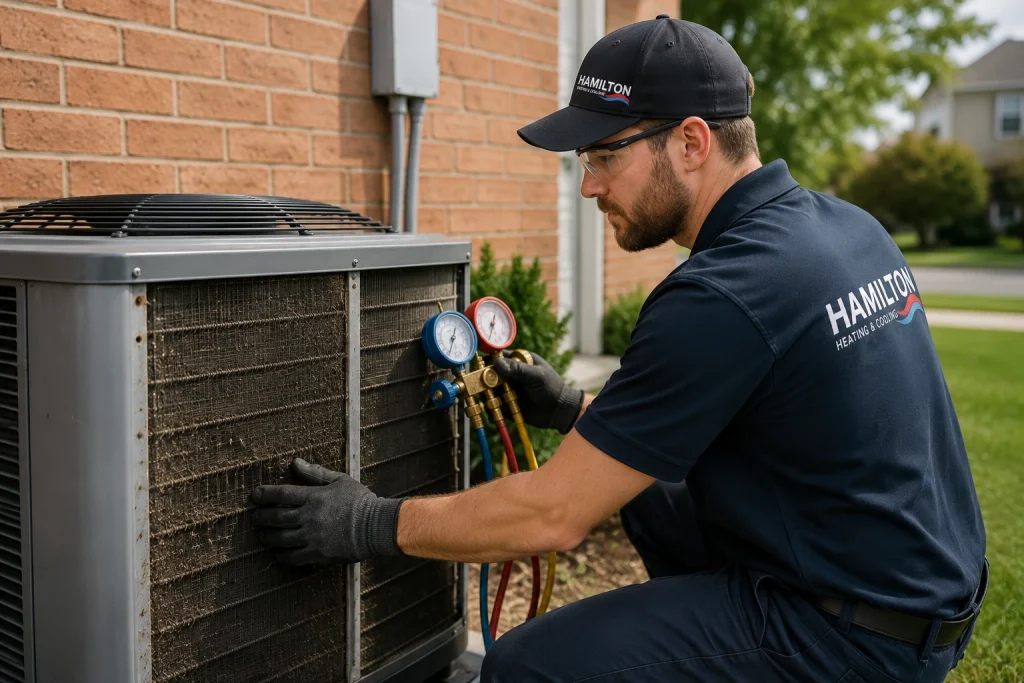
The condenser (outdoor unit) rejects heat from your home into the outside air. When the coil fins are clogged with cottonwood fluff, grass clippings, or airborne debris — all common in Hamilton summer — heat rejection efficiency drops sharply.
The system runs longer trying to accomplish the same task. A coil cleaning is typically part of an annual tune-up and takes less than an hour.
Undersized System for the Home
If your AC was improperly sized at installation — too small for the square footage, insulation level, or ceiling height — it will run constantly on any hot day without ever fully satisfying the thermostat. This is surprisingly common when homeowners replace a system without a proper Manual J load calculation.
The only real fix is a correctly sized replacement. If you're considering an upgrade, read our overview of what to check when considering AC replacement in Hamilton.
Thermostat Issues and Sensor Problems
A thermostat installed near a heat source (a sunny window, above a lamp, near the oven) reads the room as warmer than it is and signals the AC to keep running. Similarly, a failing thermostat that doesn't accurately read ambient temperature can prevent normal cycling.
Upgrading to a smart thermostat with remote sensors — placed in the rooms you actually use — is one of the most cost-effective improvements for homes that struggle with constant AC operation.
Not sure what size AC you need? Calculate the right capacity in under a minute.
Find the right AC tonnage for your home in just a few clicks.
By submitting this form, you are giving your consent to receive phone calls and text messages from our contractor partners.
Get a Confirmed Size from a Pro
A certified HVAC contractor performs a Manual J load calculation for exact sizing.
Get Free QuotesWhat to Check Yourself Before Calling a Technician
Before booking a service call, run through this sequence. Roughly 40% of Hamilton service calls during summer involve issues the homeowner could have resolved themselves — which means you might save $150–$200 and a few days' wait.
- Check and replace the air filter. Hold it up to light — if you can't see through it, replace it immediately. Use a MERV 8–11 filter for the best balance of airflow and filtration in Hamilton's air quality conditions.
- Clear the outdoor unit. Turn off power at the disconnect switch and clear any debris from around the condenser. Ensure at least 60 cm of clearance on all sides. Rinse the coil fins gently with a garden hose if they're visibly dirty.
- Check supply and return vents. Ensure no furniture, rugs, or curtains are blocking vents. Closed vents in unused rooms create pressure imbalances that reduce system efficiency across the whole house.
- Check your thermostat placement and settings. Confirm it's set to Cool, the setpoint is actually below room temperature, and it's not located near a heat source like a lamp or direct sunlight.
- Look for ice on the indoor unit or refrigerant lines. If present, switch to fan-only, check the filter, and let it thaw before restarting. If it freezes again, that's a refrigerant issue for a technician.
If these checks don't resolve constant running, or if the system isn't reaching setpoint after completing them, it's time for a professional diagnosis. See the signs you need air conditioning repair in Hamilton for more context on when DIY ends and professional service begins.
🔧 Free Estimate — No Obligation
Not Sure What's Wrong With Your AC? We'll Tell You.
Our Hamilton technicians run a full system diagnostic — refrigerant pressure, coil condition, electrical components, airflow — and give you a straight answer before any work begins. No upselling, no guesswork.
When Does an AC Running Constantly Mean It's Time to Replace?
Not every AC that runs constantly is broken — but some are simply past their effective lifespan. Here's how to assess whether repair or replacement makes more sense for your Hamilton home.
Central AC systems in Ontario have an expected service life of 15–20 years with proper maintenance. If your system is over 12 years old and you're seeing constant running combined with any of the warning signs above, the repair-vs-replace calculation changes significantly.
A system that needs a $800 refrigerant repair at age 16 may be a poor investment compared to a new high-efficiency unit that qualifies for federal and provincial energy efficiency rebates.
The general rule of thumb used by HVAC professionals: if the repair cost exceeds 50% of the replacement cost, and the system is more than 10 years old, replacement is typically the better financial decision. For a thorough breakdown of what to consider, see our guide on air conditioner replacement in Hamilton.
The ENERGY STAR program is a useful reference for understanding efficiency ratings — systems with SEER ratings of 18 or above can reduce cooling costs by 20–40% compared to a 14 SEER unit, which matters considerably when your AC is running constantly through a Hamilton summer.
Why Hamilton's Humidity Makes AC Runtime Different From Anywhere Else
Hamilton sits at the western end of Lake Ontario, and that geography matters for AC performance in a specific way: the lake moderates temperature but contributes persistent humidity throughout summer. The Escarpment also traps warm, humid air in the lower city on calm days.
This means Hamilton homeowners regularly deal with conditions that push air conditioners harder than the same thermostat setting would in a drier Ontario city.
The practical implication: your AC's "normal" runtime in Hamilton is longer than national averages suggest, and comparing your experience to what you read in American guides — written for much drier Sunbelt climates — will lead you to worry about a system that's performing perfectly.
What matters in Hamilton is relative performance over time, not absolute runtime. If your system has been cooling your home effectively for years, and it suddenly seems to be running more constantly without a corresponding heat wave, that change is the diagnostic signal — not the runtime by itself.
💰 AC Savings Calculator
Find out how much you could save on energy bills by upgrading to a high-efficiency air conditioner.
By submitting this form, you are giving your consent to receive phone calls and text messages from our contractor partners.
Start Saving — Get Free Quotes
These are estimates. Certified HVAC contractors can give you accurate savings projections based on your home.
Get Free QuotesHow to Prevent Your AC Running Constantly From Becoming a Full Breakdown
The homeowners who avoid mid-summer emergency calls share one habit: they treat the AC like a car, not a light switch. Annual maintenance is what separates a system that runs efficiently at age 15 from one that fails at age 10.
- Spring tune-up (April or May): A certified technician checks refrigerant pressure, cleans both coils, inspects electrical contacts and capacitors, lubricates moving parts, and verifies airflow. Book before the rush — availability is significantly better in spring than during a July heat wave.
- Change the filter every 4–6 weeks during cooling season. In Hamilton's pollen season (May–August), higher-traffic homes benefit from checking filters monthly. Set a phone reminder so it doesn't slip.
- Keep the outdoor unit clear year-round. Cottonwood trees (common in Hamilton's older neighbourhoods) shed heavily in June. Check and clear the condenser coil after any significant shedding event.
- Install a smart thermostat. Modern smart thermostats log runtime patterns and flag anomalies — many homeowners learn about developing AC problems from their thermostat app before they notice any discomfort.
- Act on early warning signs immediately. Unusual noises, reduced cooling, or a sudden increase in runtime during comparable weather conditions are your system asking for attention. Early intervention costs a fraction of a reactive repair.
For a full preventive maintenance checklist from our Hamilton technicians, see the AC maintenance tips from our Hamilton repair team.
Bottom Line: AC Running Constantly in Hamilton — When to Relax, When to Act
If your AC is running constantly during a heat wave and your home is reaching its target temperature, you can relax — your system is doing exactly what it's designed to do in Hamilton's humid summer climate. That's not a problem; that's performance.
If your AC is running constantly and not reaching your setpoint — or if you're noticing warm air, ice buildup, unusual sounds, or a sharp rise in your Hydro One bill — those are genuine signals worth addressing promptly. The most expensive AC repairs are usually the ones that started as small, ignored problems that got worse through a long, hot summer.
Start with the DIY checks: filter, outdoor unit, vents, thermostat. If those don't resolve the issue, a professional diagnostic is the right next step. Hamilton homeowners can also explore when AC replacement makes more sense than ongoing repair if the system is aging.
🏠 Hamilton Heating and Cooling
Ready to Get Your AC Running Right — Not Just Running Constantly?
From a quick filter check to a full system diagnostic, our Hamilton team fixes the cause — not just the symptom. Same-day availability. Straight answers. No surprises on the invoice.
📍 Serving Hamilton, Stoney Creek, Ancaster, Dundas, Waterdown & surrounding communities
Frequently Asked Questions
Yes. During Hamilton heat waves (30°C+ and high humidity), AC systems may run almost continuously. If your home reaches the set temperature, the system is working normally.
Common causes include a dirty air filter, low refrigerant, dirty condenser coils, or an undersized system. Check and replace the filter first; if the issue continues, schedule a professional inspection.
Typically 15–20 minutes per cycle in mild weather. During hot, humid Ontario summers, longer or near-continuous operation is normal if the system is maintaining the set temperature.
Yes. A clogged filter restricts airflow, reduces cooling efficiency, and can cause the AC to run continuously. Replacing the filter is the first troubleshooting step.
Only if you notice ice buildup, unusual noises, or a burning smell. Otherwise, keep it running if it’s maintaining the desired temperature during a heat wave.
