
Air conditioner replacement in Hamilton is a decision most homeowners only face once every decade or two which is exactly why it feels more overwhelming than it should. This Air Conditioner Replacement Guide is for anyone whose system is struggling to keep up with Hamilton’s humid summers, running up energy bills, or simply getting old. You’ll get the real warning signs, a clear repair-vs.-replace framework, the unit types available, common mistakes to avoid, and straight answers to the myths that trip up most first-time buyers.
No sales pitch just what actually matters when you’re comparing quotes or trying to decide if now is the right time.
❄️ Thinking About a New System?
Get a Straight Answer on Repair vs. Replace
Our Hamilton team will walk you through your options — no pressure, no upsell, just an honest assessment of your current system.
How Do You Know You Need Air Conditioner Replacement in Hamilton?
A handful of signs consistently show up before a system fails completely. As this Air Conditioner Replacement Guide explains, if you’re noticing more than one or two of these warning signs, it’s worth getting an assessment rather than waiting for a full breakdown in the middle of a heat wave.
- Your unit is 10 to 15 years old — check the nameplate on the outdoor condenser for the manufacture date
- It still runs on R-22 refrigerant (Freon) — this refrigerant is being phased out in Canada and is increasingly expensive to source
- Energy bills keep climbing each summer even though your usage hasn’t changed
- Repairs are becoming frequent and increasingly expensive to source parts for
- Your system keeps running low on refrigerant — this usually means either an incomplete charge at installation or a leak, and simply topping it up doesn’t fix the underlying problem
- Uneven cooling between rooms, or noticeable hot spots that weren’t there before
- Excess indoor humidity, musty smells, or mould developing despite regular maintenance
- Loud grinding, rattling, or whining noises from the indoor or outdoor unit
For a deeper breakdown of failure symptoms specifically, see our guide on AC repair warning signs in Hamilton.
Replacing early rather than waiting for a full breakdown has upside beyond comfort, too. As this Air Conditioner Replacement Guide explains, a correctly installed new system typically runs less humid and circulates fewer allergens through your ductwork than an aging one, and a documented, professionally installed system can support your home’s resale value particularly in neighbourhoods where updated HVAC is increasingly expected by buyers.
Should You Repair or Replace Your Air Conditioner?
A simple industry rule of thumb settles most repair-versus-replace decisions: if a repair quote comes in at 20% or more of the cost of a new unit, replacement is usually the better long-term investment especially once you factor in the lower efficiency of an aging system. This Air Conditioner Replacement Guide uses that rule to help homeowners make a more confident and cost-effective decision.
| Situation | Repair Usually Makes Sense | Replacement Usually Makes Sense |
|---|---|---|
| Unit age | Under 10 years | Over 10–15 years |
| Refrigerant type | R-410A or newer | R-22 (Freon) |
| Repair cost | Under 20% of new unit price | 20%+ of new unit price |
| Repair history | First issue in years | Second or third repair this year |
| Energy bills | Stable | Rising year over year |
If you’re leaning toward repair, our AC Repair Cost Calculator gives you a fast estimate before a technician arrives, so you can weigh it against a new system with real numbers. And if a full air conditioner repair turns out to be the right call instead, our repair team can usually get to you the same week.
By submitting this form, you are giving your consent to receive phone calls and text messages from our contractor partners.
Get an Accurate Repair Quote
A certified HVAC technician can diagnose the exact issue and provide a firm quote. Many offer free diagnostics.
Get Free QuotesWhat Types of Air Conditioners Can You Choose From?
Most Hamilton homes fall into one of four categories, each suited to a different layout and budget.
- Central split system — the most common residential option. An outdoor condenser connects via refrigerant lines to an indoor coil mounted on your furnace, cooling your whole home through existing ductwork.
- Ductless mini-split — an outdoor condenser paired with one or more wall-mounted indoor units, each with its own thermostat. A strong option for additions, renovations, or homes without ductwork.
- High-velocity compact systems — smaller ductwork that fits into tight spaces like attics or closets, popular in older Hamilton homes with limited room for conventional ducts.
- Packaged rooftop units — all components housed in a single cabinet, typically used for commercial buildings rather than residential homes.
- Window units — the least efficient option for whole-home comfort. They're noisy, block window light and views, and are only worth considering for cooling a single small room rather than replacing a central system.
Whichever type you choose, pair it with a programmable or smart thermostat modern controls let you set schedules automatically, which meaningfully cuts down on unnecessary runtime. If your current system is aging and you also handle heating, it's worth comparing straight AC replacement against a heat pump, which cools in summer and heats in winter from a single outdoor unit.
By submitting this form, you are giving your consent to receive phone calls and text messages from our contractor partners.
Get Expert Advice & Free Quotes
A certified HVAC contractor can confirm the best unit for your specific home and climate.
Get Free Quotes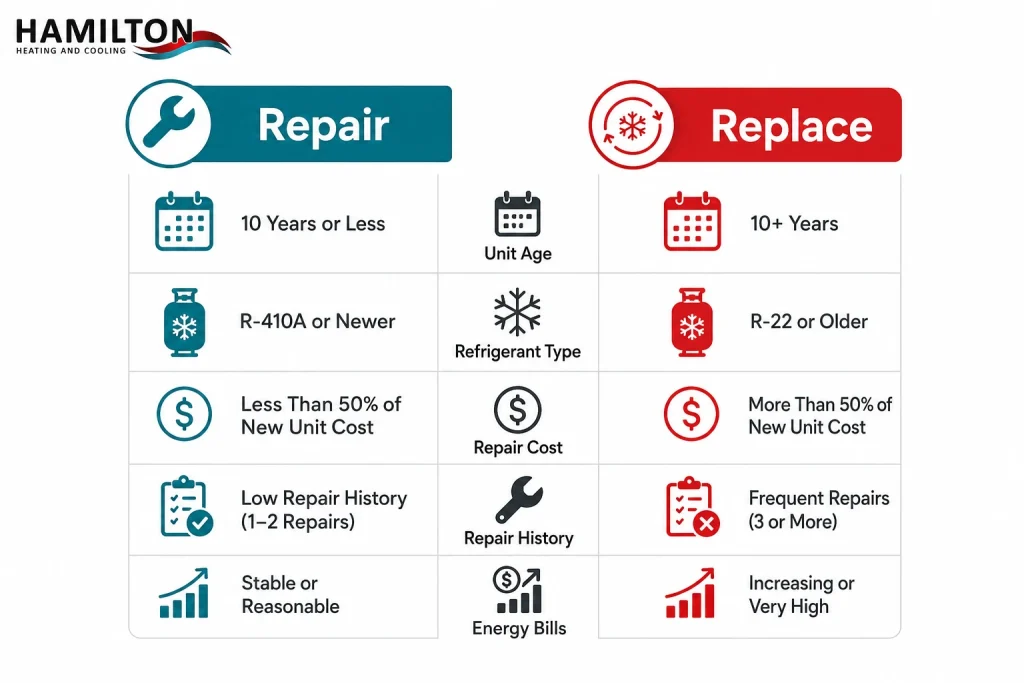
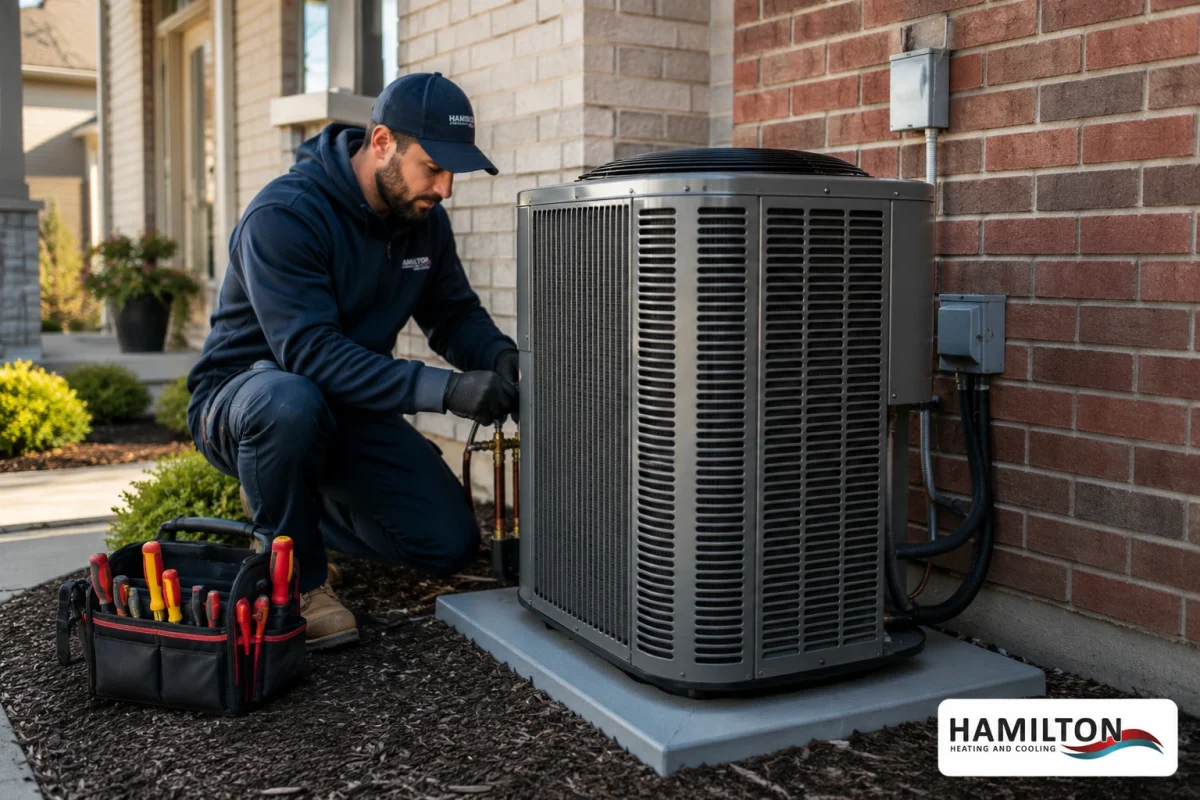
A correctly sized central split system is the most common choice for air conditioner replacement in Hamilton homes.
How Do You Get the Right Size for Your New System?
Sizing is where the most costly mistakes happen. A properly sized system is based on a Manual J load calculation, not square footage alone — factors like insulation quality, window orientation, ceiling height, and ductwork condition all affect the result. An oversized unit cools quickly but cycles too often to remove humidity properly, leaving your home cool but clammy. Use our AC Size and Tonnage Calculator for a starting estimate before your in-home assessment.
By submitting this form, you are giving your consent to receive phone calls and text messages from our contractor partners.
Get a Confirmed Size from a Pro
A certified HVAC contractor performs a Manual J load calculation for exact sizing.
Get Free QuotesCommon Mistakes to Avoid During Air Conditioner Replacement in Hamilton
These are the mistakes our team sees most often—and most are easy to avoid once you know what to watch for. This Air Conditioner Replacement Guide highlights the most common pitfalls so you can make a more informed replacement decision.
- Buying an oversized unit "to be safe." Bigger isn't better — it extracts less moisture and can leave your home feeling sticky. Whatever size you land on, look for a SEER rating of 14 or higher as a baseline.
- Waiting too long to replace. Continuing to patch an old system usually costs more over time than a planned replacement.
- Blocking supply or return vents with furniture or rugs, forcing the system to work harder than necessary.
- Placing lamps or heat-producing appliances near the thermostat, which causes it to misread room temperature.
- Hiding the outdoor unit behind dense landscaping, which restricts airflow and reduces efficiency.
- Skipping regular filter changes. A clogged filter is one of the most common causes of AC breakdowns, and a dirty filter alone can add roughly 7% to your cooling costs.
Don't Forget Your Ductwork
A brand-new air conditioner still has to push air through your existing ducts—and in many older Hamilton homes, that's where efficiency quietly disappears. As this Air Conditioner Replacement Guide explains, replacing the unit alone won't solve airflow issues if the ductwork is underperforming.
The average residential duct system runs at only around 60% efficiency, and homes with leaky ductwork can lose up to 40% of conditioned air before it ever reaches a vent. Leaky seams, overly long duct runs, and too few return vents all force your new system to work harder than it should, shortening its lifespan and creating the same hot spots you were trying to fix in the first place.
If your home is more than 15 years old or has been renovated in stages, ask your installer to inspect the ductwork as part of your replacement quote—sealing leaks is a relatively small cost compared to the efficiency you'll gain.
What Do SEER Ratings and ENERGY STAR Actually Mean?
SEER (Seasonal Energy Efficiency Ratio) measures how efficiently a system cools your home over an entire season, not just at one moment — the higher the number, the less electricity it takes to produce the same cooling. Systems carrying the ENERGY STAR label, verified by Natural Resources Canada, are independently tested to meet a higher efficiency bar than standard models sold in Canada.
Sound rating matters too: quieter units typically fall around 6.8 bels, while anything above 7.8 bels is worth reconsidering if your outdoor unit sits near a bedroom window or patio.
💰 Compare Your Options
Not Sure What a New System Will Cost You?
Use our free AC Cost Calculator to compare unit types, efficiency tiers, and installation pricing before you request a quote.
Free to use — no sign-up required.
Energy-Saving Habits After Your New Air Conditioner Is Installed
A new system runs at its best when a few simple habits support it:
- Weatherstrip doors and caulk window gaps — inexpensive fixes that reduce how hard your system needs to work
- Keep blinds closed during peak sun hours to reduce heat gain through south- and west-facing windows
- Install a programmable or smart thermostat so temperatures adjust automatically when you're away
- Replace filters monthly during peak cooling season to protect airflow and efficiency
For deeper humidity-specific advice, see our guide on AC tune-ups and Lake Ontario humidity. Curious how much a newer, more efficient unit could save you each year compared to what you're running now?
By submitting this form, you are giving your consent to receive phone calls and text messages from our contractor partners.
Start Saving — Get Free Quotes
These are estimates. Certified HVAC contractors can give you accurate savings projections based on your home.
Get Free QuotesFrequently Asked Questions
If your system is over 10–15 years old, still runs on R-22 refrigerant, or a repair quote is 20% or more of a new unit's cost, replacement is usually the better long-term choice. A single minor repair on a younger system rarely justifies replacing it.
No. Your air conditioner runs at the same speed regardless of the temperature you set it to — turning it down further doesn't cool your home any quicker, it just runs longer than necessary.
Not in summer. Turning it off entirely means your system has to work much harder to cool the house back down later, and can allow humidity and mould to build up. Raising the temperature by 7–10°F while you're out is a better balance.
No. Waiting for a full breakdown usually means an emergency decision during the hottest days of summer, often at a higher cost. Replacing proactively lets you compare options and schedule installation on your own timeline.
Sizing depends on square footage, insulation, window exposure, and ductwork condition — not square footage alone. Use our AC Size and Tonnage Calculator for a starting estimate, then confirm with a professional load calculation.
Cost varies by system type, size, and efficiency tier. Use our free AC Cost Calculator to get a realistic estimate based on your home's specifics before requesting quotes.
Look for the ENERGY STAR label, which confirms a system meets Natural Resources Canada's independently verified efficiency standard. Within your budget, a higher SEER rating means lower cooling costs over the system's lifetime.
Production and import of R-22 is banned in Canada, so only limited reclaimed supply remains, and it's increasingly expensive. If your system uses R-22, replacement is usually more cost-effective than continuing to repair it.
Not on their own. Fans move air rather than lowering temperature — the cooling sensation comes from airflow across your skin, not an actual drop in room temperature. Pairing fans with your AC can let you raise the thermostat a degree or two comfortably, but a fan left running in an empty room just wastes electricity.
No — it can actually cause problems. Closing supply vents builds up pressure in your ductwork, forcing your system to work harder and sometimes contributing to duct leaks over time. If a room genuinely doesn't need cooling, ask about a professionally installed zoning system instead of closing vents.
Final Thoughts
Air conditioner replacement in Hamilton doesn't have to be a stressful, last-minute scramble. Once you know the warning signs, understand the repair-versus-replace math, and know what to watch for during installation, it becomes a straightforward decision rather than a guessing game. The homeowners who get the best outcome are the ones who plan ahead rather than wait for a breakdown in July.
Only a TSSA-licensed technician should handle refrigerant work or gas-adjacent components, so make sure whoever you hire is properly certified. For more on Canada's refrigerant regulations, the Government of Canada's ozone-depleting substances regulations page is a useful reference if your current system runs on R-22.
📞 Ready When You Are
Get an Honest Air Conditioner Replacement Quote in Hamilton
Our locally based, TSSA-licensed team will assess your system and give you a straight answer — no pressure, no guesswork.
