
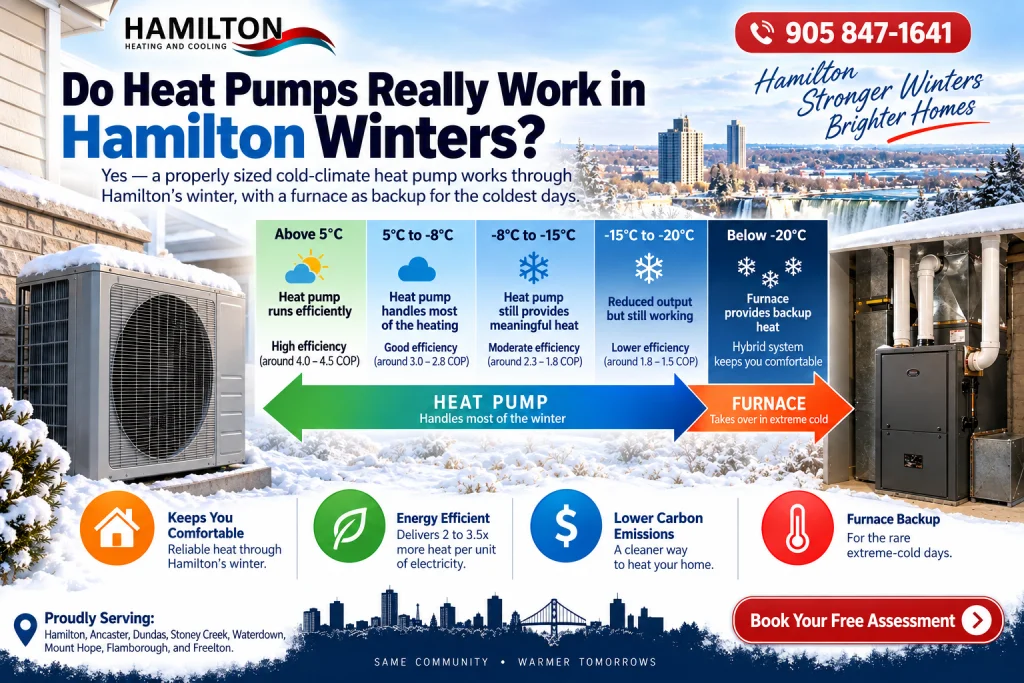
If you’ve searched “heat pump Hamilton” hoping for a straight answer on whether these things survive our winters, here it is: yes. A properly sized cold-climate heat pump works through a Hamilton winter, including the coldest nights the city typically sees.
Four things determine how well a heat pump works for your specific home: sizing, insulation, installation quality, and backup heat for the rare extreme-cold hours each winter.
This guide covers the mechanism behind that answer, not just the claim. You’ll get the real Hamilton temperature data and the exact point where a hybrid system hands off to a furnace, so you can judge the technology on facts rather than a sales pitch or a rumour from a neighbour.
If you already own a heat pump in Hamilton and it seems to be struggling right now, skip ahead to why a heat pump can feel like it’s not heating, since most of what looks like a fault is normal cold-weather behaviour.
📍 Serving: Hamilton, Ancaster, Dundas, Stoney Creek, Waterdown, Mount Hope, Flamborough, and Freelton. We’ve been installing and servicing heat pumps across Hamilton since 2000.
Guide reviewed by Hans Vaillancourt, TSSA-certified HVAC technician with over 25 years in residential heating and cooling. Verify TSSA certification.
❄️ Free Cold-Weather Check
Not Sure a Heat Pump Can Handle Your Hamilton Home?
We’ll run a real CSA F280 heat loss calculation on your specific house and tell you honestly where your balance point lands and whether a heat pump alone gets you through winter. Free, no obligation.
Do Heat Pumps Actually Work in Hamilton’s Cold Winters?
Short answer: yes, with a boundary worth knowing. The scepticism around heat pumps in this climate isn’t irrational, it’s just outdated. Heat pumps built fifteen or twenty years ago genuinely struggled once temperatures dropped much below -5°C, and a lot of the advice still circulating online or from a contractor pitching a straight furnace replacement is based on that older generation of equipment.
Cold-climate air-source heat pumps (often shortened to ccASHP) are a different category of product, using variable-speed compressors and enhanced vapour injection to keep producing meaningful heat down to roughly -25°C to -30°C, depending on the specific equipment. Hamilton’s coldest nights, even the extreme ones, sit within or right at the edge of that range for most of the season.
The part that’s genuinely true, not just a hedge, is that a heat pump’s output and efficiency both shrink as the outdoor temperature drops. This is basic thermodynamics, not a defect. It’s also the reason the rest of this guide exists, so you know what to expect instead of guessing.
What Is COP, and Why Does It Drop When It’s Cold Outside?
Short answer: COP (Coefficient of Performance) measures the heat a system delivers for each unit of electricity it consumes. As outdoor temperatures drop, COP decreases because the refrigerant system must work harder to extract heat from colder air. COP isn’t a marketing number; it describes a real physical limit.
How a Heat Pump Produces Heat
A heat pump doesn’t generate heat the way a furnace burns gas. Instead, it moves heat that already exists in the outdoor air into your home, using the same basic principle as a refrigerator running in reverse.
The refrigerant absorbs heat from outdoor air at low pressure. The compressor then raises the refrigerant’s temperature, and the indoor coil releases that heat into your home.
A COP of 3 means the system delivers roughly three units of heat for every one unit of electricity it consumes. By comparison, standard electric resistance heat has a COP of exactly 1.
Why Does COP Fall in Colder Weather?
COP drops as outdoor temperatures fall because two things happen at the same time.
First, colder outdoor air contains less thermal energy for the refrigerant to extract. Second, the temperature difference between the outdoor air and your home’s indoor temperature becomes larger.
That larger temperature gap forces the compressor to work harder to raise the extracted heat to a usable temperature. As a result, efficiency falls even when the heat pump continues producing useful heating output.
COP vs. HSPF2: What’s the Difference?
It’s worth knowing the term HSPF2 (Heating Seasonal Performance Factor) alongside COP because it appears on equipment specification sheets.
COP measures efficiency at a specific outdoor temperature. HSPF2, on the other hand, measures heating efficiency across an entire heating season.
Natural Resources Canada requires a minimum HSPF2 of 7.1 for a unit to qualify as a certified cold-climate heat pump. When comparing models, check this seasonal rating rather than relying only on a manufacturer’s headline COP at mild outdoor temperatures.
Typical Heat Pump COP at Different Temperatures
| Outdoor Temperature | Typical COP (Cold-Climate Heat Pump) | Heat Output vs Rated Capacity |
|---|---|---|
| 8°C | 4.0 – 4.5 | 100%+ |
| 0°C | 3.0 – 3.5 | ~90% |
| -8°C | 2.3 – 2.8 | ~75% |
| -15°C | 1.8 – 2.2 | ~60% |
| -25°C | 1.3 – 1.6 | ~40–50% |
Read that table as: even at a COP of 1.3 on the coldest night of the year, the system still delivers more heat than tRead the table this way: even at a COP of 1.3 on the coldest night of the year, the system still delivers more heat than the same electricity would produce through pure resistance heating.
In other words, a heat pump can have a poor night without becoming inefficient compared with a space heater. It simply loses some of the efficiency advantage it enjoys during milder weather.
Figures like these broadly track with the NEEP (Northeast Energy Efficiency Partnerships) cold-climate heat pump database, which HVAC professionals use to compare real-world capacity curves across brands. Certified cold-climate models also need to maintain a COP around 1.75 or higher at -15°C.
How to Read a Heat Pump Spec Sheet
💡 Reading a Spec Sheet the Right Way: Don’t focus only on the single COP or SEER2 number printed on the equipment literature.
Instead, look for the manufacturer’s capacity and COP data at three important temperatures:
- 8°C — the standard rating temperature
- -8°C — a useful cold-weather performance point
- -15°C — an important benchmark for cold-climate heating
The -15°C performance line gives you a much better idea of what the unit can deliver during the coldest part of a Hamilton winter. That information matters when you size the system for the home.
What Canadian Testing Shows
This isn’t just manufacturer theory. Natural Resources Canada’s Canadian Centre for Housing Technology in Ottawa tested a cold-climate heat pump against a matched house using standard heating equipment. Researchers used two identical, highly instrumented homes to compare performance.
The published results showed that the cold-climate heat pump, combined with appropriately sized backup heat, maintained comfortable indoor conditions during the coldest outdoor temperatures encountered in the study, which fell below -21°C.
The system also maintained a COP above 1.5. That means it remained more efficient than standard electric resistance heat rather than simply defaulting to it.
This test provides a useful reference because Ottawa typically experiences colder winter conditions than Hamilton. You can read the full Canadian Centre for Housing Technology assessment directly.
How Cold Does It Actually Get in Hamilton, Compared With What a Heat Pump Can Handle?
Short answer: Hamilton’s average January low sits around -7°C to -8°C, and the city typically sees only about two nights a year that drop into the -20s°C. A true -30°C reading remains rare here. That matters when you compare Hamilton’s winter temperatures with the operating ranges that cold-climate heat pump manufacturers rate their equipment for.
Hamilton’s Typical Winter Temperatures
Environment Canada’s climate normals put Hamilton at roughly 49 frost days a year, meaning days when temperatures dip below 0°C at some point. These frost days occur mainly from November through April.
That gives you useful context when looking at heat pump performance. Most of a typical Hamilton winter falls within the COP 2.5 to 4.0 range from the table above. The lower COP 1.3 to 2.0 range generally appears only during the coldest handful of nights.
Why Hamilton’s Climate Matters for Heat Pumps
A lot of the doubt around heat pumps in this climate comes from a mismatch of assumptions. People often picture the much harsher winters found in the Prairies or northern Ontario.
Hamilton benefits from its proximity to Lake Ontario, which moderates temperature extremes compared with some inland Southern Ontario locations at a similar latitude. As a result, Hamilton rarely experiences the prolonged extreme cold that can challenge heat pump performance in colder regions.
What Temperature Do Engineers Use for HVAC Sizing?
For HVAC sizing, engineers don’t simply use the coldest temperature Hamilton has ever recorded. Instead, they use a CSA F280 design temperature to determine the heating requirements for a home.
For Hamilton, that design temperature generally falls around -18°C, although the figure can run a degree or two colder on the Mountain and in other more exposed parts of the city.
This distinction matters because a properly sized cold-climate heat pump doesn’t need to handle Hamilton’s absolute record low every winter. It needs to provide adequate heating capacity around the design conditions while working efficiently through the much larger number of milder winter hours.
Hamilton’s Climate Zone
Hamilton also falls within Climate Zone 6, the same zone used across our other heat pump and furnace sizing tools on this site.
Taken together, these factors explain why a properly selected cold-climate heat pump can work effectively in Hamilton. The system needs the right capacity, correct installation, suitable controls, and appropriate backup heat for the occasional extreme-cold period.
| Metric | Hamilton (Environment Canada Climate Data) | Typical Cold-Climate Heat Pump Rating |
|---|---|---|
| Average January low | -7°C to -8°C | Full-capacity operating range |
| Coldest nights (roughly 2/winter) | Low -20s°C | Reduced capacity, still functional |
| Extreme/record cold | Rarely approaches -30°C | Near or beyond rated minimum on some models |
Put simply, for the vast majority of a Hamilton winter, a properly sized cold-climate heat pump operates well inside its comfort zone rather than scraping against a hard limit. The handful of nights that push toward the edge of the manufacturer spec are exactly what a balance point and backup heat plan exist to cover, covered next.
Home construction era changes this picture too. Century homes in areas like Westdale, Durand, and Kirkendall tend to have thinner wall assemblies and less consistent air sealing than post-1980 builds in Ancaster or Stoney Creek, which pushes their heat loss curve higher at every outdoor temperature and directly affects where a home’s balance point lands. If you’re weighing equipment options for an older home without existing ductwork, our ductless mini-split guide covers how construction era affects installation options in more depth.
🧮 Free Calculator
See What Your Heat Pump Would Actually Cost to Run
Estimate your monthly heating and cooling cost based on system size and Hamilton’s electricity rates, factoring in exactly the cold-weather efficiency drop-off covered above.
Heat Pump Operating Cost Calculator
Calculate the estimated monthly operating cost of your heat pump for heating or cooling with this quick quiz.
COP (Coefficient of Performance) measures heating efficiency. Higher = more efficient. Check your manual or use the default.
SEER (Seasonal Energy Efficiency Ratio) measures cooling efficiency. Higher = more efficient.
Check your electricity bill or use the Canadian average.
By submitting this form, you are giving your consent to receive phone calls and text messages from our contractor partners.
IMPORTANT: This is a general estimate for informational purposes only. Actual costs vary based on usage patterns, local weather, thermostat settings, and equipment age.
Get Accurate Quotes from Local Pros
These are estimates. Get precise quotes from certified contractors — for free.
GET FREE QUOTESWhat Is a Balance Point, and When Does a Hybrid System Switch to the Furnace?
Short answer: most Hamilton homes that add a heat pump keep their existing furnace and run a hybrid (dual-fuel) system, where the heat pump handles most of the season and the furnace steps in automatically during the coldest stretches. The setting controlling that handoff is the balance point, and there are actually two of them worth telling apart, since contractors and homeowners often talk past each other by conflating the two.
The Thermal Balance Point
This is the outdoor temperature at which the heat pump's remaining capacity exactly equals your home's heat loss at that same temperature. Above this point, the heat pump carries the full load on its own. Below it, the heat pump alone can no longer keep up, regardless of running cost, and something else has to make up the difference.
This point depends on your home's heat loss rate (insulation, windows, air sealing) as much as it depends on the equipment itself, which is why two identical heat pumps installed in two different Hamilton homes can land on different thermal balance points. A proper calculation starts with a CSA F280 heat loss calculation for the specific house at Hamilton's design temperature. CSA F280 is the Canadian standard for residential heating and cooling load calculations, and it's the methodology a qualified installer should use here, not a US-based Manual J calculation, which uses different assumptions and design temperatures that don't map cleanly onto a Canadian home.
The Economic Balance Point
This is a different question: at what outdoor temperature does it become cheaper to run the furnace instead of the heat pump, even when the heat pump can technically keep up?
As COP falls with outdoor temperature, the cost of producing each unit of heat with the heat pump rises. Eventually, that cost crosses the cost of producing the same amount of heat with the furnace.
The exact crossover depends on three factors: your local electricity price, your local natural gas price, and your furnace's AFUE rating.
When Is It Cheaper to Run the Furnace Instead of the Heat Pump?
This is a different question: at what outdoor temperature does it become cheaper to run the furnace instead of the heat pump, even when the heat pump can technically keep up?
As COP falls with outdoor temperature, the cost of producing each unit of heat with the heat pump rises. Eventually, that cost crosses the cost of producing the same amount of heat with the furnace.
The exact crossover depends on three factors: your local electricity price, your local natural gas price, and your furnace's AFUE rating.
What Is the Economic Balance Point?
Below the economic balance point, running the furnace costs less even though the heat pump hasn't technically reached its heating limit.
A well-configured hybrid system uses this economic balance point, rather than relying only on the thermal balance point, as its actual switchover setting. That setting can have a direct impact on your winter energy bill.
Because electricity and gas rates can change throughout the year, the economic balance point can change too. That's why our Heat Pump Savings Calculator estimates the crossover using current Hamilton-area energy rates rather than relying on a fixed number that could become outdated.
Worked Example: A Hamilton Bungalow
💡 Worked Example: Consider a well-sealed Hamilton bungalow with a heat loss of roughly 24,000 BTU/hr at -18°C.
Suppose the home has a 3-ton cold-climate heat pump rated for about 30,000 BTU/hr at 0°C but only 18,000 BTU/hr at -15°C.
Under those conditions, the home will typically reach a thermal balance point around -9°C to -11°C. Once electricity and natural gas prices enter the calculation, the economic balance point can land a few degrees warmer.
That means the furnace may make financial sense to switch on slightly before the heat pump reaches its maximum heating capacity.
These figures are illustrative. Your actual thermal and economic balance points depend on your home's CSA F280 heat-loss calculations, specific equipment, electricity rates, and natural gas rates.
Typical Hybrid System Switchover Temperatures
For many properly sized hybrid systems in the Hamilton area, technicians typically set the switchover somewhere around -8°C to -15°C after considering both thermal capacity and operating costs.
Homes with better-than-average insulation can sometimes push that setting lower. Better insulation reduces the home's heat loss, allowing the heat pump to handle a larger share of the heating season before the system needs to bring in the furnace.
Why Furnace Condition Still Matters
A well-maintained furnace also matters when you rely on it as winter backup.
If your furnace needs attention before the heating season, our furnace repair guide covers common problems worth checking before you depend on it during the coldest weather.
Why Does Frost Build Up on the Outdoor Unit in Winter, and Is That a Problem?
Short answer: light frost on the outdoor coil is normal in humid, freeze-thaw climates like Hamilton's, and the unit's own defrost cycle clears it automatically. It's a problem only when heavy ice builds up and doesn't clear.
The outdoor coil absorbs heat from the outdoor air, which means its surface temperature runs colder than the air around it. Hamilton's Lake Ontario proximity means plenty of outdoor humidity, and when that moisture meets the cold coil surface, it condenses and freezes onto it, the same way frost forms on a cold windshield. Icing tends to happen most aggressively in a specific band, roughly -4°C to 2°C with high humidity, because air in that range holds enough moisture to build frost quickly without being too cold to hold much moisture at all. If your unit defrosts a handful of times during a damp, hovering-around-freezing day, that's expected, not a fault.
To deal with the buildup, the system periodically reverses its refrigerant cycle for five to fifteen minutes, running briefly in a mode identical to air conditioning, sending hot refrigerant to the outdoor coil to melt the frost off. During this defrost cycle, the indoor unit may blow noticeably cooler air and you might see steam rising off the outdoor unit as the ice melts. Both are the system working correctly.
The distinction that actually matters: a light, even frost that visibly clears during each defrost cycle is normal. Heavy, thick ice that doesn't fully clear, or ice that builds back faster than the unit can remove it, usually points to a failing defrost sensor, a struggling fan motor, or a refrigerant charge issue, and that's when it's worth a technician visit rather than a wait-and-see approach.
When Does the Backup Furnace Actually Kick In on a Hybrid System?
Short answer: a properly configured hybrid system switches to the furnace automatically once outdoor temperature drops through the home's specific balance point. The thermostat or an outdoor sensor handles the handoff, so nothing needs to happen manually.
A dual-fuel thermostat is programmed with the balance point temperature determined during installation. Once the outdoor sensor reads at or below that number, the control board locks out the heat pump's compressor and hands heating duty entirely to the gas furnace, which doesn't lose capacity in cold weather the way a heat pump does. Above that temperature, the reverse happens, since the heat pump is the cheaper option to run whenever it can keep up.
What we typically see on Hamilton service calls lines up with what the balance point math predicts: hybrid systems in properly insulated homes spend the bulk of the heating season running on the heat pump alone, with the furnace only engaging during the coldest overnight stretches each winter. Homes with older envelopes or undersized equipment lean on the furnace more often, which is a sizing and insulation conversation, not a sign the heat pump itself is underperforming.
Why Does My Heat Pump Feel Like It's Not Heating My Hamilton Home Properly?
Short answer: Cooler-than-expected supply air and brief cool blasts during a defrost cycle can both occur normally. A genuinely inadequate heating problem has a much shorter list of likely causes, and you can diagnose many of them before calling for service.
Why Heat Pump Air Feels Cooler Than Furnace Air
One frequent and entirely normal cause deserves attention on its own: a gas furnace typically delivers supply air around 45°C to 60°C, while a heat pump more commonly delivers air around 30°C to 40°C.
That air remains warmer than your room temperature and continues to heat your home. It simply doesn't feel as hot against your hand at the vent.
This difference in comfort perception causes many homeowners to think their heat pump isn't producing enough heat when the system actually works normally.
Check Your Air Filter First
A dirty air filter remains one of the most common causes of weak heating output.
A clogged filter restricts airflow across the indoor coil, which can noticeably reduce heating capacity. Checking or replacing the filter takes only a few minutes and provides an easy first step before you call a technician.
Check the Heat Pump's Balance Point
A balance point set too high can also create the impression that your heat pump isn't working properly.
When the system reaches an unnecessarily high switchover temperature, it brings in backup heat sooner than necessary. The heat pump may still have enough capacity to heat the home, but the controls prevent it from doing so.
We've covered the thermal and economic balance points in detail above.
Low Refrigerant Can Reduce Heating Capacity
A low refrigerant charge reduces heating capacity across the outdoor temperature range, not just during extreme cold.
A licensed technician needs to diagnose and correct refrigerant problems. Don't attempt to add refrigerant yourself.
Check for Excessive Ice Buildup
A light layer of frost on the outdoor coil normally develops during cold, humid weather, and the heat pump should periodically remove it through a defrost cycle.
However, heavy ice buildup that doesn't clear can indicate a failing defrost sensor, a struggling fan motor, or another system problem.
If the unit repeatedly remains heavily iced after its defrost cycle, schedule a professional inspection.
Keep Snow and Debris Away From the Outdoor Unit
Snow, leaves, and other debris can restrict airflow around the outdoor unit and reduce heating performance.
Keep at least 18 inches of clearance around all sides of the outdoor unit throughout winter. Check the area regularly after heavy snowfall or strong winds.
Frozen Refrigerant Lines vs. Normal Surface Frost
⚠️ Frozen Refrigerant Lines vs. Surface Frost: A light, even layer of frost on the outdoor coil is normal during cold, humid weather.
Thick ice concentrated around the refrigerant lines or the base of the unit, especially when it returns quickly after a defrost cycle, can indicate a refrigerant charge problem, failing defrost sensor, or fan issue.
Don't attempt to diagnose or repair these problems yourself. Refrigerant work in Ontario requires the appropriate certified professional.
What Can You Safely Check Yourself?
You can safely handle two basic checks:
- Replace or inspect the air filter.
- Clear snow and debris from around the outdoor unit while maintaining proper clearance.
Leave refrigerant problems, control-board diagnostics, defrost sensor replacement, and other technical repairs to a qualified technician with the appropriate Ontario certification.
If the heat pump still struggles to maintain your home's temperature after these basic checks, professional diagnosis can identify the underlying problem before it causes further damage.
🩺 Free Diagnostic Tool
Heat Pump Not Heating Properly?
Pick the symptom you're seeing, cold air, ice buildup, or backup heat running constantly, for a likely cause, what's safe to check yourself, and when it's time to call a technician.
Heat Pump Troubleshooting Wizard
Answer 5 quick questions about your heat pump symptoms and get a likely diagnosis with recommended next steps.
By submitting this form, you are giving your consent to receive phone calls and text messages from our contractor partners.
Note: This diagnosis is based on common symptom patterns and is for informational purposes only. A certified HVAC technician should inspect your system for an accurate diagnosis.
Get a Professional Diagnosis
Connect with certified local contractors who can diagnose and fix your heat pump — for free quotes.
GET FREE QUOTESAre the Common "Heat Pumps Don't Work in Cold Climates" Claims True?
A quick myth-by-myth check, since most of these circulate as certainty when the reality is more specific:
- Myth: heat pumps are only for warm climates. Reality: cold-climate models are widely installed across Canada, the Nordic countries, and the northern United States specifically because they're built for cold-climate performance, not despite it.
- Myth: they stop working somewhere around -15°C to -20°C. Reality: that's roughly where a standard, non-cold-climate heat pump starts to struggle. NEEP-listed cold-climate models are specifically tested and rated to keep meaningful output at and below that range.
- Myth: a heat pump always costs more to run than a gas furnace. Reality: it depends on local electricity versus gas pricing and the heat pump's COP at the outdoor temperature in question. Above the economic balance point, the heat pump is typically cheaper; below it, the furnace usually is. That's the whole reason hybrid systems exist.
- Myth: switching to a heat pump means ripping out your existing ductwork and furnace. Reality: a hybrid setup reuses your existing furnace and ducts. Homes without ductwork, common in older lower-city Hamilton housing stock, are often better suited to a ductless mini-split system instead.
- Myth: if the air doesn't feel hot at the vent, it isn't really heating the house. Reality: as covered above, lower, steadier supply air temperature is how these systems are designed to operate, not a sign of underperformance.
Heat Pump vs Furnace: Which Wins at Which Temperature?
Short answer: a heat pump wins on running cost through most of a Hamilton winter. A furnace wins on raw output and consistency during the coldest snaps. A hybrid system is designed to hand the job to whichever one is winning at any given moment.
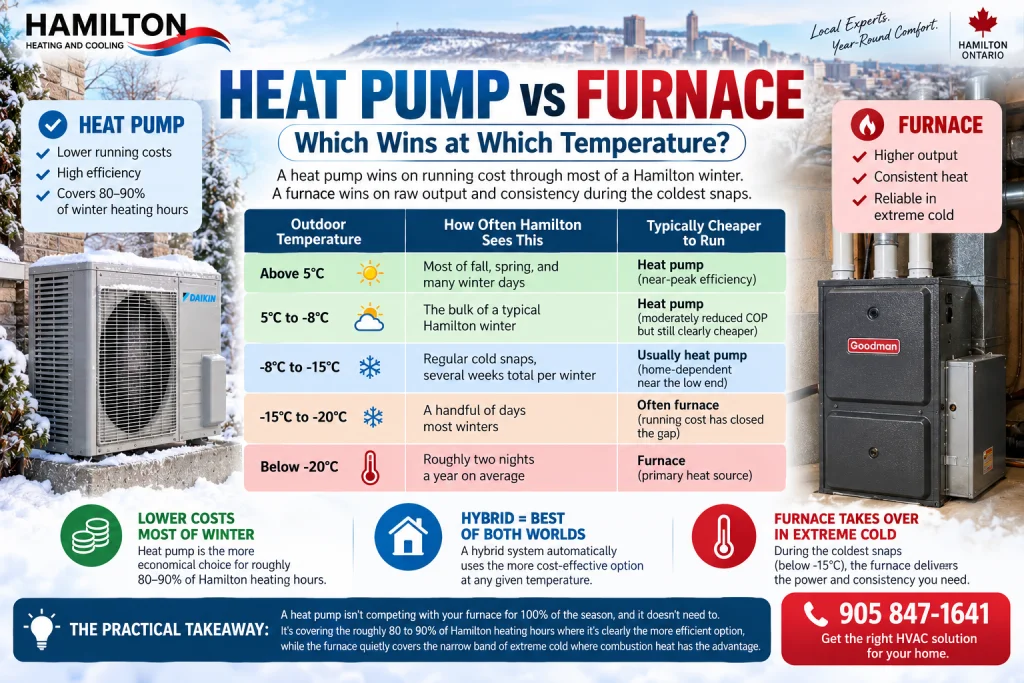
| Outdoor Temperature | How Often Hamilton Sees This | Typically Cheaper to Run |
|---|---|---|
| Above 5°C | Most of fall, spring, and many winter days | Heat pump, near-peak efficiency |
| 5°C to -8°C | The bulk of a typical Hamilton winter | Heat pump, moderately reduced COP but still clearly cheaper |
| -8°C to -15°C | Regular cold snaps, several weeks total per winter | Usually heat pump, home-dependent near the low end |
| -15°C to -20°C | A handful of days most winters | Often furnace, running cost has closed the gap |
| Below -20°C | Roughly two nights a year on average | Furnace, primary heat source |
The practical takeaway: a heat pump isn't competing with your furnace for 100% of the season, and it doesn't need to. It's covering the roughly 80 to 90% of Hamilton heating hours where it's clearly the more efficient option, while the furnace quietly covers the narrow band of extreme cold where combustion heat has the advantage. The real question isn't "heat pump or furnace," it's whether your home's balance point and equipment sizing let a hybrid system lean on the cheaper option as often as possible.
What Rebates Are Available for Hamilton Homeowners?
Short answer: Ontario's current provincial route runs through the Home Renovation Savings program, delivered through Enbridge Gas and Save on Energy with Ontario government backing, plus local financing through the City of Hamilton's Better Homes Hamilton program. Both currently expect a proper CSA F280 load calculation as part of a qualifying installation, so this isn't a step to skip even if you're confident about sizing.
Program rules, eligible equipment lists, and dollar amounts change over time and are frequently tied to specific application windows or evaluation requirements, so treat any specific figure as a starting point rather than a guarantee. Our heat pump services page keeps current rebate amounts up to date, and our team confirms your exact eligibility before you commit to anything, at no charge.
- Current eligibility and application steps: Enbridge Gas / Save on Energy Home Renovation Savings
- Cold-climate heat pump technical standards: Natural Resources Canada, Air-Source Heat Pumps
- City of Hamilton local financing details: hamilton.ca/betterhomeshamilton
Is a Heat Pump the Right Fit for Your Hamilton Home?
Short answer: it depends heavily on what you're switching from and how your home is insulated. The physics in this guide are the same for every house, but the balance point, the payback period, and the honest recommendation are specific to yours.
A heat pump is generally a strong fit when you want lower running costs for most of the year and are comfortable keeping a furnace as backup, when your home is reasonably well insulated, when you also want air conditioning from the same equipment, or when you're replacing an aging air conditioner anyway and the step-up cost is smaller than starting from scratch. Homes currently on oil, propane, or electric baseboard heat tend to see the clearest financial case, since a heat pump typically moves 2 to 3.5 units of heat per unit of electricity consumed compared to a roughly 1-to-1 ratio for baseboards.
It's a more marginal decision, worth a real conversation rather than a rule of thumb, if your home has an unusually high heat loss rate, if your local electricity-to-gas price ratio currently favours the furnace at most winter temperatures, or if a straight furnace replacement solves your immediate problem on a tight budget. None of these situations rule a heat pump out, but they change the sizing, the switchover point, and the payback timeline enough that a generic online answer won't be accurate for your specific house.
📊 Free Savings Tool
Compare Your Current System Against a Heat Pump
Estimate your annual savings switching from gas, oil, propane, or electric baseboard heat, based on real Hamilton fuel-cost data.
Heat Pump Savings Calculator
Get a quick estimate on how much you could potentially save in heating costs by switching from your current system to an air-source heat pump.
Your actual bills help us provide a more accurate estimate. If not, we can estimate based on similar homes in your region.
Check your utility bills or estimate based on your monthly costs.
AFUE = Annual Fuel Utilization Efficiency. Higher % = more efficient.
Older systems run less efficiently, so your actual savings may be even higher.
By submitting this form, you are giving your consent to receive phone calls and text messages from our contractor partners.
Important: This is a general estimate for informational purposes only. Actual savings vary based on equipment choice, local utility rates, usage patterns, and installation quality. Get quotes from certified contractors for accurate numbers.
Get Accurate Quotes from Local Pros
Find out exactly how much you could save — get free quotes from certified contractors.
GET FREE QUOTESEither way, the honest answer for your specific house comes from an actual CSA F280 heat loss calculation and balance point estimate, not a rule of thumb pulled from someone else's home. If you want to browse the underlying mechanics further, our heat pump services page covers installation specifics and current rebate amounts, our Goodman furnace guide walks through hybrid dual-fuel pairings in more detail, and our heating and cooling resources hub covers related topics like furnace maintenance and system sizing.
🧮 Free Balance Point Estimate
Want the Real Numbers for Your Specific House?
Run the calculators above for a starting estimate, then reach out for a proper CSA F280 heat loss calculation and balance point assessment on your actual home. Free, no pressure.
🔒 Free assessment · No obligation · Licensed Hamilton technicians
Hamilton Heating and Cooling · 21 King St W, 5th Floor, Hamilton, ON
