

Indoor air quality tips Hamilton homeowners search for usually come up after they notice something off: a musty smell when the AC kicks on, more dust than usual on the furniture, or family members sneezing more indoors than outside. If that sounds familiar, you’re not imagining it. Hamilton’s humid summers, older housing stock near the escarpment and lakeshore, and ductwork that often runs through damp basements all work against clean indoor air.
This guide covers six practical, low-cost steps for improving indoor air quality in a Hamilton home, based on the checks our technicians walk homeowners through during service calls. You’ll learn what to inspect, what’s worth buying, and when a simple habit isn’t enough and it’s time to call a professional.
📋 Quick Answer
6 Indoor Air Quality Tips for Hamilton Homes
The fastest path to cleaner indoor air in a Hamilton home:
- ✅ Inspect and seal leaky air ducts
- ✅ Install a smart thermostat that tracks humidity and filters
- ✅ Clean carpets and rugs weekly
- ✅ Ventilate on dry, low-pollen days
- ✅ Add a few air-purifying plants
- ✅ Keep humidity between 30% and 50% with a dehumidifier
Why Indoor Air Quality Matters More in Hamilton Homes
Homes closer to Lake Ontario deal with heavier summer humidity than most of Southern Ontario, and that moisture has to go somewhere. Combined with older ductwork, damp basements, and furnaces paired with AC coils that weren’t always sized for today’s tighter, better-insulated homes, it’s a near-perfect setup for dust, mould, and allergens to build up unnoticed.
None of this is dramatic on its own. But over a full Hamilton summer, small issues compound: a slightly leaky duct, an overdue filter, carpets that trap more than they show. Health Canada’s guidance on indoor air contaminants lists dust, mould, and pet dander among the most common triggers for allergy and respiratory symptoms at home, which is why small maintenance habits matter more than one big fix.
Indoor Air Quality Tips Hamilton Homeowners Can Use Today
Here’s what actually moves the needle, starting with the biggest source of hidden contamination: your ductwork.
1. Inspect and Seal Your Air Ducts
Your air ducts distribute hot and cold air to every room in the house, which also makes them one of the biggest factors in how clean that air actually is. If ducts weren’t installed or sealed properly, dander, dust, and sometimes mould can build up inside them and get pushed straight into your living space every time the system runs.
Check the joints where two duct sections connect, since that’s where leaks most often start. Hold your hand near the seam while the system is running; if you feel air escaping, mark the spot so a technician can seal it properly. Left alone, leaky ducts don’t just hurt air quality, they also make your system work harder, which is one of the common AC repair issues we see across Hamilton homes.
2. Install a Smart Thermostat to Track Humidity and Filters
A Wi-Fi enabled smart thermostat does more than control temperature. Many models monitor indoor humidity levels in real time and flag when your filter’s efficiency starts dropping. Some smart filters can even track pollen counts, which is useful during Hamilton’s spring and early summer allergy season.
The filter piece matters more than most homeowners realize. A filter that’s overdue for a change doesn’t just restrict airflow, it lets more dust and bacteria recirculate through the house, and it’s one of the more preventable reasons homeowners end up needing air conditioning repair in Hamilton earlier than expected.
3. Clean Carpets and Rugs Weekly
Carpets and rugs make a home more comfortable, but their fibres also trap dust, pet dander, and other particles that get kicked back into the air with every footstep. A weekly vacuum, ideally with a HEPA-filter vacuum, removes far more of this buildup than an occasional deep clean. It’s a small habit, but it consistently shows up as one of the more effective indoor air quality tips for Hamilton homes with pets or young kids.
4. Know When to Ventilate Your Hamilton Home
When Hamilton’s weather cooperates, typically the shoulder seasons rather than peak summer humidity, opening windows for even 15 to 20 minutes helps flush out stale indoor air. This matters most during activities like painting, cleaning with strong chemical products, or any renovation work that kicks up dust and volatile organic compounds (VOCs).
Health Canada’s guidance on ventilation and the indoor environment points out that newer, tightly sealed homes trap pollutants more easily than older, draftier ones, which makes deliberate ventilation more important, not less, as homes get more energy efficient.
5. Add a Few Air-Purifying Plants
If you want a natural, low-maintenance way to support indoor air quality, a few well-placed houseplants help. Ferns, peace lilies, and larger palms are known for pulling common airborne pollutants out of a room. They won’t replace proper filtration, but they’re an easy, inexpensive addition to bedrooms and living spaces.
6. Control Humidity With the Right Dehumidifier Settings
Humid air is one of the biggest contributors to mould and mildew in Hamilton homes, especially in basements and anywhere ductwork runs through damp spaces. If the air inside feels sticky or heavy, that’s usually your cue that it’s time for a dehumidifier.
Setting your dehumidifier to keep indoor humidity around 50% or below makes a noticeable difference, and it lines up with Health Canada’s Healthy Home Guide, which recommends keeping household humidity between 30% and 50% to limit mould growth while avoiding the dry-air problems that come with too little moisture. Pay closer attention to kitchens and bathrooms, where moisture levels tend to run higher than the rest of the house. If you’re weighing a whole-home option, our guide on AC tune-ups and Lake Ontario humidity breaks down how your cooling system and humidity control work together, and our humidifiers Hamilton page covers year-round options for both ends of the humidity range.
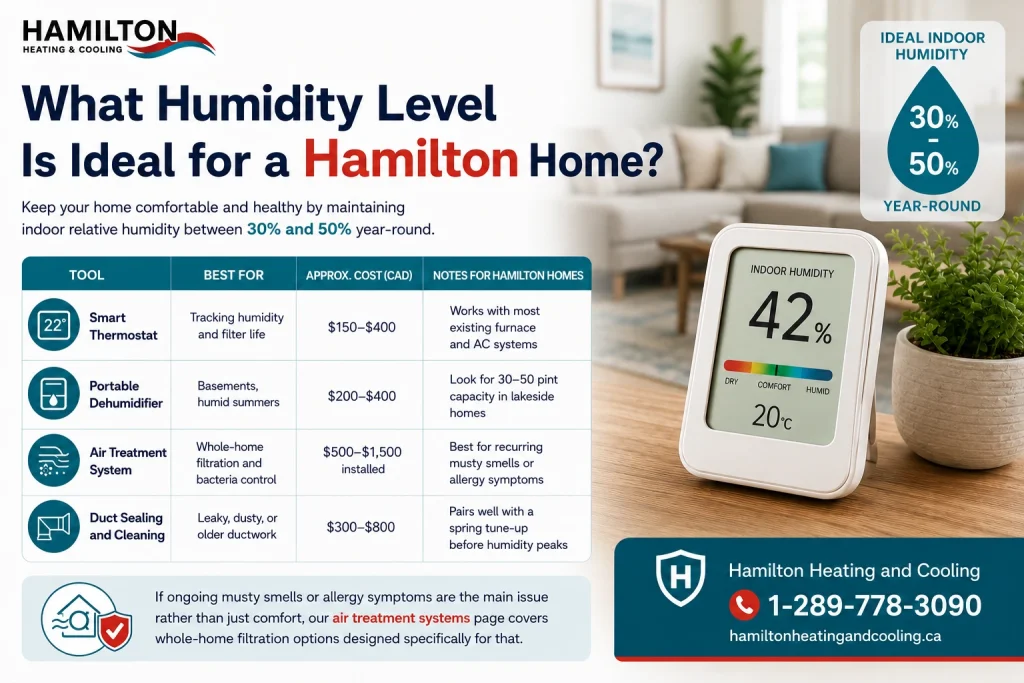
What Humidity Level Is Ideal for a Hamilton Home?
Most sources, including Health Canada, point to the same target: keep indoor relative humidity between 30% and 50% year-round. Below that range, dry air tends to cause static and irritated sinuses; above it, you’re in mould and dust mite territory. Here’s how the main tools for getting there compare:
| Tool | Best For | Approx. Cost (CAD) | Notes for Hamilton Homes |
|---|---|---|---|
| Smart Thermostat | Tracking humidity and filter life | $150–$400 | Works with most existing furnace and AC systems |
| Portable Dehumidifier | Basements, humid summers | $200–$400 | Look for 30–50 pint capacity in lakeside homes |
| Air Treatment System | Whole-home filtration and bacteria control | $500–$1,500 installed | Best for recurring musty smells or allergy symptoms |
| Duct Sealing and Cleaning | Leaky, dusty, or older ductwork | $300–$800 | Pairs well with a spring tune-up before humidity peaks |
If ongoing musty smells or allergy symptoms are the main issue rather than just comfort, our air treatment systems page covers whole-home filtration options designed specifically for that.
Common Indoor Air Quality Mistakes Hamilton Homeowners Make
A few habits quietly work against everything above, even when the intent is right:
- Skipping filter changes to save money — an overdue filter recirculates more contaminants than it catches, and often costs more later in repairs
- Assuming carpets just need vacuuming occasionally — trapped dust and dander build up faster than most people expect
- Running the AC nonstop without addressing humidity — cooling and humidity control are related but separate problems
- Ignoring a musty smell because the AC still cools fine — air quality and cooling performance don’t always fail together
- Never checking duct seams — most homeowners never think to check where ducts connect, even though that’s a common leak point
When to Call a Professional for Indoor Air Quality Problems in Hamilton
The tips above cover what you can handle yourself. A few situations are worth escalating: recurring musty smells that come back after cleaning, visible mould near vents or on ductwork, a system that seems to be not cooling properly alongside poor air quality, or any of the warning signs your AC needs repair. These usually point to something inside the ductwork or coil that a filter change or air purifier won’t fix.
🔧 Free Diagnostic Tools
Not Sure What’s Behind Your Air Quality Issue?
Answer a few quick questions and our free AC Troubleshooting Wizard helps pinpoint the likely cause. Then use the Repair Cost Calculator to see what fixing it typically runs.
By submitting this form, you are giving your consent to receive phone calls and text messages from our contractor partners.
Get a Certified Tech to Confirm
Our diagnosis is a starting point. A certified HVAC technician can confirm the issue and fix it right the first time.
Get Free QuotesBy submitting this form, you are giving your consent to receive phone calls and text messages from our contractor partners.
Get an Accurate Repair Quote
A certified HVAC technician can diagnose the exact issue and provide a firm quote. Many offer free diagnostics.
Get Free QuotesBoth tools are free to use, no sign-up required.
Frequently Asked Questions
Inspecting air ducts for leaks, keeping filters current, cleaning carpets weekly, ventilating on dry days, adding a few houseplants, and keeping humidity between 30% and 50% cover the most impactful, low-cost steps.
Hold your hand near duct joints while the system runs; escaping air usually means a leak. Higher than expected dust buildup near vents is another common sign.
They don't filter air directly, but they track humidity and filter efficiency, which helps you catch problems before they affect air quality.
Health Canada recommends keeping indoor relative humidity between 30% and 50% year-round to limit both mould growth and dry-air irritation.
Ferns, peace lilies, and larger palms are commonly cited for helping filter airborne pollutants, though they work best alongside proper filtration rather than as a replacement.
A weekly vacuum, ideally with a HEPA filter, keeps trapped dust and dander from building up and recirculating through the home.
Open windows during dry, low-humidity stretches, especially during painting, cleaning, or renovation work that raises indoor pollutant levels.
If the air inside feels sticky or heavy, or musty smells keep returning in the same rooms, that's a strong sign humidity is running above the recommended 50% range.
Final Thoughts
None of these indoor air quality tips require a major renovation or a full system replacement. A sealed duct, a fresh filter, a weekly vacuum, and humidity kept in the right range cover most of what's causing stale, dusty, or musty air in a Hamilton home. The families who avoid recurring problems usually aren't doing anything dramatic, they've just built these checks into their regular routine.
If you've worked through this list and something still feels off, that's usually a sign the issue is inside your ductwork or cooling system rather than something a filter or plant can fix. For more on how your HVAC system connects to overall air quality, our heating and cooling resources hub covers related topics like tune-ups, humidifiers, and seasonal maintenance.
📞 Ready When You Are
Let's Get Your Hamilton Home's Air Quality Sorted
From duct inspections to full air treatment systems, our EPA-certified team can help you find exactly what's affecting your indoor air.
