

Quick answer: Protect a water heater from a Hamilton deep freeze by keeping its space above freezing, insulating exposed hot and cold lines, and knowing the warning signs. If lines freeze, shut off the water, never use an open flame to thaw them, and call a licensed professional.
This guide is for Hamilton homeowners whose water heater sits in a garage, a crawl space or against an exterior wall. It covers water heater freeze protection in Hamilton, plus the furnace and humidifier lines that share the same cold spaces, so you know what to do before the cold arrives and what to do if it does.
Which water heater setups are most at risk in a Hamilton deep freeze?
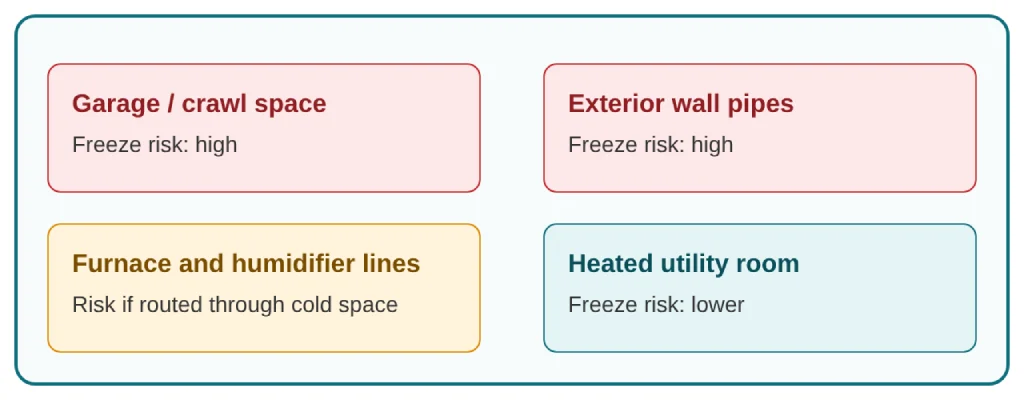
The risk comes from where the unit and its lines sit, not from the brand or age. Any water in a pipe or fitting that sits in an unheated space for long enough at below-freezing air temperature can freeze, and frozen water expands with enough force to split rigid parts. The table below ranks common setups.
| Setup | Freeze risk | Why |
|---|---|---|
| Unheated or attached garage | High | Large doors leak cold air, and the space often has no heat source. |
| Basement crawl space or unfinished corner | High | Lines run near rim joists and uninsulated foundation walls. |
| Pipes on an exterior wall | High | The wall cavity can sit far below room temperature. |
| Outdoor-vented tankless unit | Medium to high | Narrow passages freeze fast, and protection may rely on power. |
| Heated utility room or finished basement | Lower | Stable temperature, though lines leaving the room can still be exposed. |
Worried about your garage or crawl space install?
A technician can check which lines sit in unheated space before the next deep freeze.Book a Service Call
Why do water heaters and exposed lines freeze at all?
Water expands as it turns to ice, and pipes, valves and heat exchangers cannot absorb that pressure. Manufacturer guidance states that both tank and tankless heaters can freeze, most often in unheated garages, basements and crawl spaces, and that supply and outlet pipes, valves, fittings and heat exchangers are the parts at risk (Rheem).
Small-diameter pipes with little flow freeze first because they hold little heat. A pipe on an exterior wall can also sit well below the temperature of the room beside it, which is why a house that feels comfortable can still have a frozen line.
Connected HVAC lines belong in the same check. A high-efficiency furnace drains condensate through a small line, and a humidifier has its own water supply line. If either runs through a cold basement corner or crawl space, it can freeze the same way. A technician can tell you which of your lines are exposed. For the furnace side of winter readiness, see our furnace maintenance tips and furnace safety checklist.
How severe do Hamilton cold snaps get, and what do Environment Canada alerts mean?
Environment Canada alerts are built around how cold it feels to people, so treat them as a prompt to check your pipes, not as a pipe-freezing forecast. For southern Ontario, an extreme cold warning has been issued when the temperature is forecast to feel like -30 or colder for at least two hours (as explained by The Weather Network). Environment Canada has since moved to impact-based alerts, and its public alert criteria page now points to new Impact Guides, so check the current alert wording rather than relying on a fixed number.
The cold is real locally. A recent winter cold snap brought wind chills of about -30 to -35 across southern Ontario, including Hamilton, according to Global News coverage.
Wind chill does not freeze pipes by itself. Pipes freeze when the air around them stays below 0 °C long enough. An unheated garage during a multi-day cold stretch is the real danger, and a long run of cold nights matters more than one very cold hour.
Homes across Hamilton, Stoney Creek, Ancaster, Dundas, Waterdown, Glanbrook and Mount Hope vary a lot in how exposed their utility spaces are. Older homes with additions, converted garages or unfinished crawl spaces tend to have the coldest runs, though only an inspection can confirm yours.
What are the best ways to prevent a water heater from freezing?
Keep the space warm first, then protect the pipes, then add backup measures for the coldest nights. Work through these in order.
1. Keep the space above freezing
Leave the heating on, including when you travel, and avoid setting the thermostat very low. If the heater is in a garage or crawl space, make sure that space gets some heat or is sealed against drafts. Check for gaps around pipe penetrations, rim joists and the garage door seal.
2. Insulate exposed hot and cold lines
Foam pipe sleeves on the first stretch of cold supply and hot outlet lines slow heat loss and are a low-cost job. Insulation slows freezing but does not stop it in a cold enough space, so it works best alongside a heated space.
3. Use heat tape only when it is rated for the job
Heat tape or heat cable must match the pipe material and be installed exactly as the manufacturer directs. Do not wrap it near a gas water heater’s venting or relief valve discharge, and do not overlap it. Have a licensed professional install it near any gas appliance.
4. Let a faucet drip on the coldest nights
Moving water is harder to freeze. On extreme-cold nights, a thin steady drip from a tap on an exterior wall can help, though it is a short-term measure and does not replace insulation or heat. Manufacturer guidance also lists allowing small water flow during severe cold (Rheem).
5. Protect the power supply
Many tankless units rely on built-in electric freeze protection, which only works with power. In an outage during a cold snap, that protection is off. Read the unit’s manual and ask your installer what happens in your model during a power cut.
Is a tank or tankless water heater more likely to freeze?
Both can freeze, but tankless units carry extra risk because their narrow internal passages and heat exchanger can ice up quickly. A tank holds a large volume of water that cools slowly, so the connected pipes are usually the weak point. Rheem notes that tankless systems are particularly susceptible because ice forms rapidly in narrow channels.
| Factor | Tank | Tankless |
|---|---|---|
| Main weak point | Exposed supply and outlet pipes, valves | Heat exchanger, small internal passages, plus pipes |
| Built-in freeze protection | Usually none beyond the space staying warm | Often electric, so it depends on power |
| Effect of a power cut | Pipes still at risk, but a large water volume cools slowly | Freeze protection may stop working |
| Where it matters most | Garage or crawl space installs | Garage, exterior wall or outdoor-vented installs |
If you are weighing a replacement, our tankless water heater guide covers cost and winter performance, and the benefits of a new water heater covers the tank side. Freeze exposure should be part of that decision, since the best location is often a heated utility room.
What are the warning signs that a water heater or its lines have frozen?
The three clearest signs are no hot water, unusual banging or knocking, and visible frost on an exposed pipe. Check them quickly when a cold snap hits.
| Sign | What it can mean | What to do |
|---|---|---|
| No hot water, or no water at all | Ice blocking a supply or outlet line | Check exposed lines for frost, then follow the emergency steps below. |
| Banging or knocking in the pipes | Partial blockage or pressure changes from ice | Do not keep running the unit. Shut off the water and call a professional. |
| Frost or ice on an exposed pipe | The line is freezing or already frozen | Raise the room temperature gradually. Never apply a flame. |
| Dripping or damp spots after a thaw | A crack that was held shut by ice | Shut off the water and call a professional right away. |
Several of these overlap with ordinary faults, which is why our guide to water heater warning signs is worth keeping handy. In a cold snap, ask first whether the lines could be frozen before assuming the unit has failed.
What should you do if your water heater lines freeze?
Shut off the water supply, do not use an open flame to thaw anything, and call a licensed professional.
- If you can do it safely, shut off the water supply to the heater at the cold water valve and shut off power or fuel to the unit. Rheem’s guidance for a frozen unit is to cut power or fuel and turn off the water first.
- Do not run or relight a frozen heater. A heater running with blocked or frozen lines can be damaged or unsafe.
- Let thawing happen gradually by raising the room temperature. Never force it with heat.
- Look for cracks, moisture or leaks once things thaw. A split pipe can stay sealed with ice and only leak when it melts.
- Call a licensed professional to inspect before restoring service. Gas appliances must be serviced by a TSSA-registered contractor in Ontario (TSSA).
Never thaw with an open flame. Torches, lighters and propane heaters can ignite insulation, vent products or nearby materials, and can damage pipe fittings. If you smell gas at any point, leave the house and call your gas utility or 911 from outside, as you would for any gas smell.
Is a pre-winter water heater check worth booking?
Yes, if your heater or its lines sit in a garage, crawl space or exterior wall. A visit before the cold arrives lets a technician check insulation, exposed lines, condensate and humidifier drain paths, venting and the age of the unit while the weather is still easy to work in. Ask the technician these questions:
- “Which of my water and condensate lines run through unheated space?”
- “Does my unit have built-in freeze protection, and does it need power to work?”
- “Is heat tape suitable here, and who should install it?”
- “If the unit is more than ten years old, is replacing it before winter worth considering?”
Our water heater services in Hamilton page covers repair, replacement and emergency options. If you also want the furnace checked before the cold, see furnace tune-up and how heat pumps handle Hamilton cold.
What can freeze protection not do?
No insulation, tape or drip routine guarantees a pipe will not freeze in a cold enough space, and none of it makes a damaged unit safe. A heater that has already frozen may have hidden cracks even if it seems to work again. Costs of inspection or repair depend on the damage, and this article does not quote prices. For general inspection costs, see our HVAC inspection cost guide.
Government guidance on preparing for extreme cold also focuses on people’s safety during these events (the Government of Canada’s extreme cold preparedness page), so keep your own plan for a heating or power failure.
Book a pre-winter water heater check in Hamilton
Ask for a freeze-risk review of your water heater, condensate line and humidifier line while the weather is still mild. Book a Service Call Call 905 847-1641 See water heater services
