

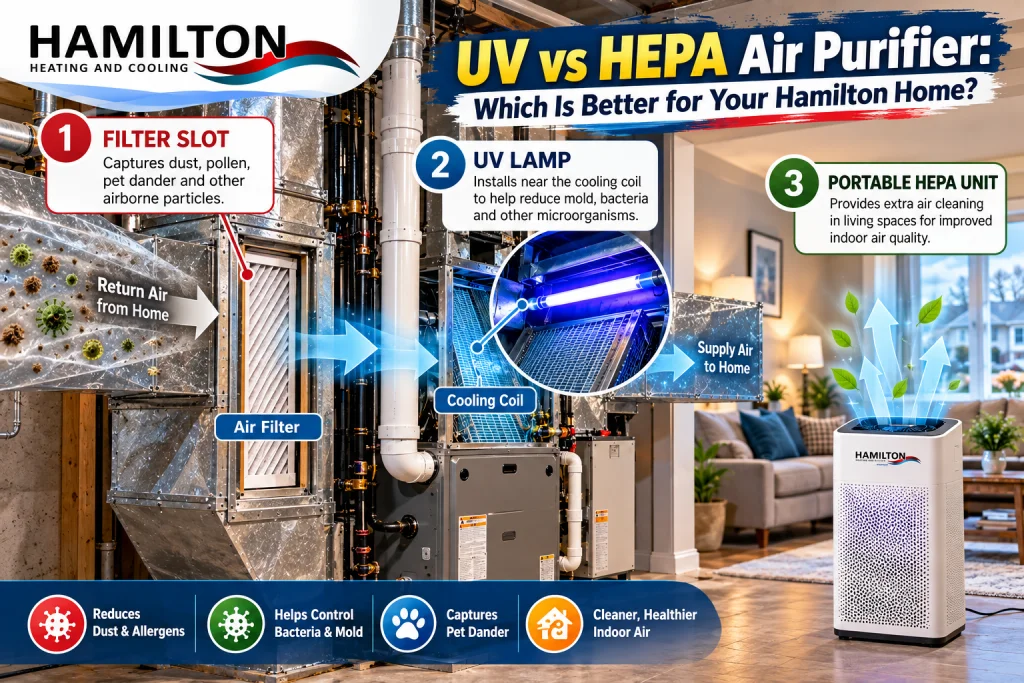
Quick answer: When comparing UV vs HEPA air purifier options, HEPA removes airborne particles such as dust, pollen, pet dander, and wildfire smoke, while UV-C treats microorganisms such as mould and bacteria. UV-C works best when properly installed and aimed at your AC coil. They solve different indoor-air-quality problems, so choose based on your specific concern rather than the marketing. For one room, a portable HEPA air purifier is usually the practical choice look for a properly sized unit with an effective HEPA filter and suitable room coverage, rather than choosing based on its UV label alone.
This guide is for Hamilton homeowners weighing a UV vs HEPA air purifier before spending money. It explains what each does, which one suits allergies, smoke or a musty AC smell, where portable units with both technologies fit, and what to check before anyone installs anything.
Whether you are comparing HEPA vs UV air purification for the whole house or for one bedroom, the right answer starts with the problem you are trying to solve.
Not sure which one you need? A technician can look at your system and your symptoms and tell you.Book a free assessment
Which one do I need for allergies, smoke or a musty AC smell?
Match the tool to the symptom. Most homes need one of these, not both.
| Your situation | Start with | Why |
|---|---|---|
| Sneezing, itchy eyes, pet dander | HEPA | Allergens are particles, and UV does not remove particles |
| Wildfire smoke days | Portable HEPA unit | Smoke is made of fine particles (PM2.5) |
| Musty smell in the first minutes of AC startup | Clean the coil, then UV at the coil | Growth on a wet evaporator coil |
| Damp basement smell all year | Fix moisture first | Neither device dries a wet space |
Is UV or HEPA better for allergies?
HEPA. Pollen, dust mite debris and pet dander are particles, so they need something that physically captures them. UV light only acts on microorganisms. If you also have a musty smell from the AC, that is a separate problem with a separate fix.
Should I fix moisture before buying anything?
Yes. Dry the space first, then choose equipment. Mould needs moisture, so a damp basement or a clogged condensate line will keep producing it whatever filter or lamp you add. Start with the source, whether that is a leak, high humidity or a blocked drain, and see our guide to basement humidity and dehumidification in Hamilton homes.
What is the difference between UV and HEPA air purification?
HEPA traps particles. UV disrupts microorganisms. Neither does the other’s job.
The US EPA describes a HEPA filter as a pleated mechanical filter that can theoretically remove at least 99.97% of particles at 0.3 microns, the most penetrating particle size. Larger and smaller particles are caught even more efficiently. The filter holds what it catches until you replace it.
UV-C light damages the DNA of bacteria, mould and some viruses so they cannot reproduce. It does nothing about dust, pollen or pet hair. Diagram comparing UV vs HEPA air purifier placement in a Hamilton home HVAC system Return air passes a filter slot, then the blower, then the evaporator coil where a UV-C lamp is aimed at the coil. Supply air reaches a room that also holds a portable HEPA unit. Return air Filter slot Higher MERV media or HEPA bypass Blower Evaporator coil UV-C lamp aimed at the coil Supply air Room Portable HEPA unit Where each option sits: a filter at the return, UV aimed at the coil, and a portable HEPA unit in the room you use most.
| HEPA filter | UV-C lamp at the coil | Portable HEPA + UV unit | |
|---|---|---|---|
| Targets | Dust, pollen, dander, smoke, mould spores | Mould and bacteria, mostly on the coil | Particles through the HEPA stage, plus a UV stage |
| Removes particles | Yes | No | Yes, through the HEPA stage |
| Treats microbes | Traps them | Inactivates them (dose dependent) | UV stage, limited by short air exposure |
| Wildfire smoke | Yes, fine particles | No | Yes, through the HEPA stage |
| Musty AC smell | Limited help | Often, when the coil is the source | No, it never reaches the coil |
| Gases and VOCs | No | No | Only with a carbon stage, and gas removal has no widely used rating |
| Typical form | Portable unit, or a filter in your system | Lamp in the furnace or air handler | Room unit |
| Upkeep | Replace filters | Replace the lamp, often yearly | Replace filters, plus the lamp if the maker specifies |
| Airflow impact | Can restrict flow in a furnace | None | None on your furnace |
| Main limitation | Only treats air that passes through it | Depends on lamp strength, placement and exposure time | Covers one room |
| Common mistake | Forcing true HEPA into a system not built for it | Trusting a bulb that still glows | Buying on the UV label instead of room size and CADR |
Do UV light air purifiers in HVAC systems actually work?
Yes, when intensity, placement and exposure time are right. The “kills 99.9%” claim means little without those three.
UV effectiveness depends on dose, which is lamp intensity multiplied by exposure time. Air moving through a duct passes a lamp in a moment. A lamp aimed at the coil keeps shining on the same wet surface, so exposure is far longer. That is why coil placement usually makes more sense than trying to treat fast-moving air.
The duct cleaning trade group NADCA says placement is everything and that a single lamp placed at random in an HVAC system will have little effect. It adds that UV can reduce airborne pathogens only when lamps are properly and strategically installed, in sufficient number or intensity, and maintained.
Some purifier makers go further and argue UV inside a small purifier is nearly pointless because air spends so little time near the lamp. That is a fair point for in-duct and in-unit air. It does not cover the coil, where the surface stays put and the lamp keeps working on it.
What about “hospital-grade” claims?
Treat them as marketing, not a rating. Ask for numbers you can compare: lamp wavelength, where it mounts, what it is aimed at, and when it needs replacing.
Does UV remove odours or gases?
No. UV acts on microorganisms. Odours and VOCs need an activated carbon stage, and Health Canada notes there is no widely used performance rating for filters designed to remove gases.
What should happen before a UV lamp is installed?
Clean the coil and check the drain first. NADCA says source removal of contaminants remains the single best method for cleaning an HVAC system, with UV as a supporting tool. A lamp is not a substitute for a clean coil.
Before installing UV, a careful technician will typically:
- Inspect and clean the evaporator coil.
- Check the drain pan and condensate line for standing water.
- Aim the lamp at the coil, not into open space.
- Protect or replace nearby plastics, since UV-C can damage non-metallic parts unless they are UV-rated.
If a quote skips all of that, ask why. A coil and drain check is also part of a proper AC tune-up, so ask whether it can happen in the same visit.
Does UV fix a musty AC smell on its own?
Not reliably. Clean the coil and clear the drain first, then consider UV to keep growth down. Our guide on why your AC smells musty covers the other causes, including a dry P-trap and a clogged condensate line.
What a typical musty-smell visit looks like (illustrative, not a specific job): the smell shows up for the first few minutes when the AC starts. A technician checks the filter, looks at the drain pan and condensate line for standing water, inspects the evaporator coil, and cleans whatever is dirty. Only once the coil and drain are in good shape does it make sense to talk about a UV lamp to keep growth down.
Want your coil and drain checked before you choose?Ask for an inspection first, then decide on UV. See AC repair and inspection in Hamilton
How long does a UV lamp last, and how do I know it still works?
Plan on replacing it about once a year unless the maker says otherwise. That same Carrier manual tells owners to replace the bulbs annually to maintain lamp potency. It covers one manufacturer’s coil kit, so follow the guidance for your own lamp.
A bulb can keep glowing after its germicidal output has dropped, so you cannot judge it by eye. Ask the installer to write the install date on the access panel, and put the replacement date on your calendar. Annual servicing is a natural time to do it. See how often your air conditioning should be serviced.
Is it safe to handle a UV-C lamp myself?
No. Leave lamp installation and replacement to a licensed professional.
UV-C light can harm eyes and skin. Power to the lamp should be off before anyone opens a panel, and the system should have proper safety interlocks. Do not look at a lit lamp, and do not open the unit while it is powered. For the wider picture on what is safe to touch, read can I service my AC myself.
Can UV lamps damage my HVAC system?
They can wear out non-UV-rated plastics and rubber over time. A Carrier installation manual for its cooling-coil UV-C kit warns that UV-C can damage non-metallic components unless they are UV-rated. This is why placement and materials matter, and why a proper install matters more than the lamp itself.
Can a standard furnace use a true HEPA filter?
Usually not directly. True HEPA media is dense enough to restrict airflow, which can strain the blower in a system built for a standard filter. Trade guidance points to two workable routes: a dedicated bypass setup, or thick high-efficiency media in a deeper cabinet.
That is different from a purpose-built whole-home system. Our air purification systems are designed to work with your existing furnace, and a technician sizes them to your airflow.
Is a MERV 13 filter a middle path?
Often, yes, if your furnace can handle it. The EPA explains that MERV reports how well a filter captures particles between 0.3 and 10 microns, and a higher rating traps specific particle sizes better. Canadian smoke guidance from the Intact Centre on Climate Adaptation suggests an HVAC filter of MERV 13 or higher during smoke events if it is compatible with your system, and running the fan continuously. A denser filter restricts airflow more, so ask a technician to confirm what your blower can take before you upgrade. A filter and blower check is part of a good furnace tune-up.
Running your furnace fan more often also helps. Health Canada’s wildfire smoke guidance lists a high quality filter and running the furnace fan often as ways to filter indoor air. See Health Canada on using an air purifier for wildfire smoke.
Should I buy a portable air purifier with HEPA and UV built in?
Choose it for the HEPA filter and the room size. Treat the UV as a bonus. Many units sold in Canada pair a HEPA filter with a UV-C lamp, and the UV label gets most of the marketing.
Health Canada’s guidance on choosing a portable air cleaner points to the things that matter more:
- Look for a device certified by the Association of Home Appliance Manufacturers (AHAM).
- Check the suggested room size and the clean air delivery rate (CADR) on the AHAM label.
- For fine particles, choose the highest tobacco smoke CADR that fits your budget. This also applies to wildfire smoke.
- As a guideline, the tobacco smoke CADR should be at least two-thirds of the room’s area.
- Avoid devices that produce ozone.
What are the pros and cons of a portable HEPA plus UV unit?
Good for one room, limited beyond it.
- Pros: no installation, handles smoke and allergens in the room you use most, easy to move, and Health Canada notes devices can be chosen for lower noise.
- Cons: covers one room, does not reach your coil, the UV stage gets only a brief look at passing air, UV-C can wear plastics and gaskets inside the unit over time, and filters need regular replacement. Check the maker’s lamp and warranty guidance before you buy.
| Room | Area | Minimum tobacco smoke CADR |
|---|---|---|
| 10 ft by 12 ft bedroom | 120 sq ft | About 80 |
| Ceilings higher than 8 ft | Ratings assume 8 ft | Choose a unit rated for a larger room |
A portable unit cleans one room. It will not treat your coil, so it will not fix a musty smell that starts in the air handler.
What does each option cost to own?
The purchase price is only part of it. Filters and lamps are the ongoing cost.
| Option | Upfront | Ongoing | Ask before you buy |
|---|---|---|---|
| Portable HEPA or HEPA + UV unit | Basic room units are listed at $500 to $1,500 on our air purification page | Filter replacements on the maker’s schedule, electricity, and a lamp if the maker specifies one | What do replacement filters cost, and how long do they last? |
| Higher-MERV or HEPA bypass in your system | Whole-home systems are listed at $1,500 to $4,500 and up | Filter changes on a set schedule, plus an airflow check | Can my blower handle it? |
| UV at the coil | Included in HEPA, carbon and UV systems listed at $2,000 to $5,500 and up | A replacement lamp about once a year, plus coil and drain care | What does the lamp cost, and when is it due? |
Those figures come from our air purification page. Every home is different, so use them as a starting range only.
If you want an expert opinion before you spend, see what is typically covered in an HVAC inspection in Hamilton.
Do air purifiers actually improve health?
They can reduce particles you breathe, but they are not the first fix. Health Canada says portable air cleaners can help by removing small particles, and that the best ways to improve indoor air are to remove the source of contaminants and to ventilate with clean outdoor air.
A sound approach is to deal with sources, moisture and filtration before buying equipment. Our indoor air quality tips for Hamilton homeowners walk through the source-control steps.
Is ozone from air purifiers a risk?
Yes. Avoid anything that deliberately produces ozone. Health Canada’s portable air cleaner guidance says to avoid devices that produce ozone, because ozone can harm your health.
Some UV lamps can also produce ozone depending on the wavelengths they emit. Ask for an ozone-free lamp, and ask the installer to confirm it in writing.
Does Hamilton’s climate change whether I need UV or HEPA?
It tilts the decision toward moisture control, then filtration. Hamilton sits between Lake Ontario and the Niagara Escarpment, summers can be humid, and many older homes keep damp basements. Our AC smells guide notes that older housing near the escarpment and lakeshore often has ductwork running through those damp basements. A wet coil and a damp basement are where mould problems start.
- Humid summers: more condensation on the coil. Our guide on AC tune-ups and Lake Ontario humidity explains why. Our AC smells guide also notes that homes within a few kilometres of the lakeshore tend to need coil and condensate line inspections more often.
- Damp basements: control humidity first. See basement humidity and dehumidification in Hamilton homes.
- Smoke days: check the Air Quality Health Index for your area and keep a portable HEPA unit ready.
Timing tip: if you want UV for the cooling season, install it in spring before the coil runs daily. Our spring AC maintenance guide covers the visit. Buy the portable HEPA unit before you need it, not on the first bad-air day.
Can I use UV and HEPA together?
Often yes, if you have both problems. Otherwise start with the one that matches your symptom.
A layered setup is common: a good filter or portable HEPA for particles, UV near the coil for microbial growth, and regular maintenance underneath. If you already have a HEPA purifier, add UV only when you have a coil or microbial problem, such as a musty smell at AC startup.
If you are weighing the UV side, see our UV air purifier installation in Hamilton, Ontario page. For the particle side, our complete HEPA guide explains true HEPA versus “HEPA-style” filters.
What should I ask before buying a UV or HEPA system?
Ask these eight questions. A good installer will answer all of them without hesitation.
- Which problem am I solving: particles, microbes or moisture?
- Has the coil been cleaned and the drain checked?
- Where exactly does the lamp go, and what is it aimed at?
- Is the lamp ozone-free, and can you confirm that in writing?
- When does the lamp need replacing, and what does a replacement cost?
- Will you write the install date on the access panel?
- Is a true HEPA actually compatible with my furnace, or do I need a bypass or a portable unit?
- For a portable unit: is it AHAM certified, and is the CADR right for the room?
Exact wording you can use: “Can you show me where the lamp mounts and what it is aimed at?” “Is the lamp ozone-free, and will you put that in writing?” “Will you write the install date on the access panel and tell me when to replace the lamp?” “Has the coil been cleaned and the drain checked first?”
Hamilton Heating and Cooling serves Hamilton and nearby communities, including Stoney Creek, Ancaster, Dundas, Waterdown, Glanbrook and Mount Hope.
Who can tell me which one my Hamilton home needs?Our technicians can check your system and give you a clear recommendation.Book a free assessment Call 905 847-1641
More Hamilton HVAC guides
- AC smells in Hamilton: what each odour means
- Indoor air quality tips for Hamilton homeowners
- Basement humidity and dehumidification in Hamilton
- What a furnace tune-up should include
- Browse the full resource library
Hamilton Heating and Cooling
21 King St W, 5th Floor, Hamilton, ON L8P 4W7
905 847-1641 | info@hamiltonheatingandcooling.ca | Mon to Fri 8:00 to 19:00, Sat 9:00 to 16:00, 24/7 emergency service
