
If you want to lower your water heating bill, the fastest savings usually don’t come from buying a new tank. Instead, they come from a handful of proven adjustments that many Hamilton homeowners haven’t made. Water heating is typically the second-largest energy cost in a home, right behind space heating and cooling. Even small setup mistakes can increase your energy bills month after month. This guide explains which changes make the biggest difference, which common tips are actually myths, and which tasks you can safely handle yourself. It also shows when it’s time to call a licensed technician.
Hamilton’s mix of older homes, harder lake-sourced water, and long Ontario heating seasons puts extra strain on many water heaters. As a result, they often cost more to operate than the manufacturer’s performance estimates suggest. That’s why every recommendation in this guide is written specifically for Hamilton homeowners.
💧 Not Sure Where Your Money Is Going?
Get a No-Guesswork Water Heater Check-Up in Hamilton
Our team can pinpoint exactly what’s driving up your hot water costs — and tell you honestly whether it’s a quick fix or worth replacing.
Why Is Your Water Heating Bill So High in Hamilton Homes?
Most Hamilton households are paying more than they need to for one of a few reasons: a thermostat still set at the factory default of 140°F (60°C), sediment buildup from harder water reducing tank efficiency, ageing insulation on an older tank, or simple habits long showers, half-empty dishwasher loads that add up over a billing cycle.
None of these require a full system replacement to fix. They just require knowing which lever to pull first. Across homes we’ve worked on in Hamilton, Ancaster, Dundas, and Stoney Creek, the households with the highest hot water costs almost always have two or more of these issues stacked together a slightly-too-hot thermostat, a tank that hasn’t been flushed in years, and a small leak nobody’s gotten around to fixing. Individually, each one seems minor. Combined, they add real money to a bill every single month.
How Much Can You Save by Lowering Your Water Heater Temperature?
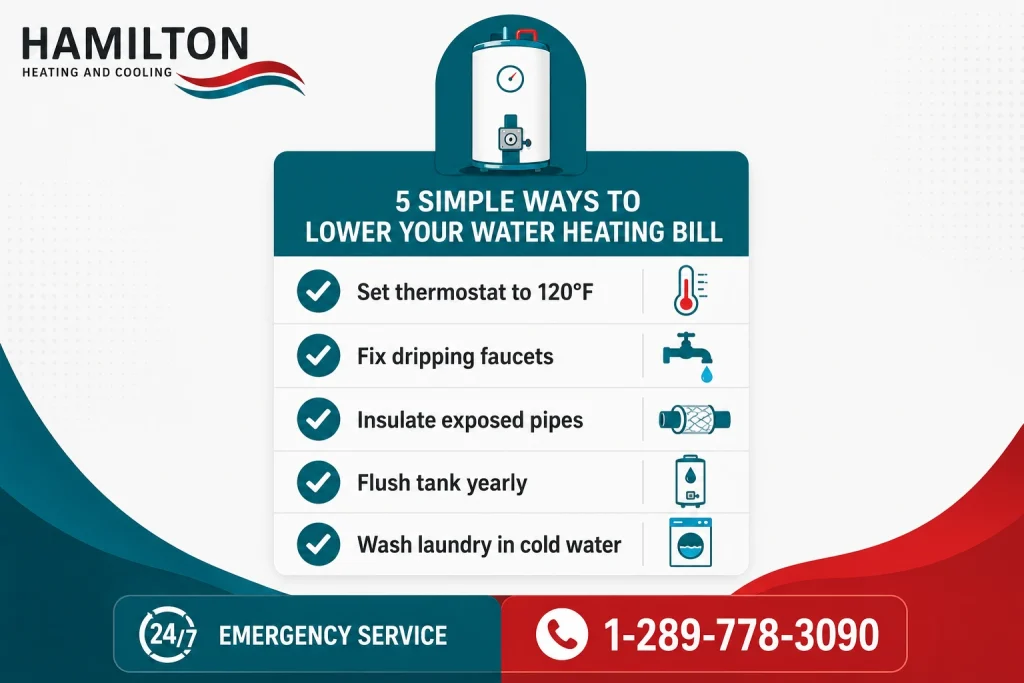
Most water heaters ship set to 140°F, which is hotter than almost any household actually needs. Dropping the thermostat to 120°F (48°C) is one of the single most effective ways to lower your water heating bill, and most homeowners don’t notice any difference in shower comfort.
Is 120°F Actually Safe for Your Household?
Yes, for most families. Health Canada and most manufacturers consider 120°F a safe, standard setting that also lowers scald risk for young children and older adults. The main exception is households with someone immunocompromised, where a slightly higher setting paired with a mixing valve is sometimes recommended worth a quick conversation with a technician if that applies to your home.
Are Small Leaks Really Costing You That Much Every Month?
Yes this is the one most people underestimate. A single leaking faucet can waste dozens of gallons of hot water a day, and a meaningful share of household plumbing leaks waste well over 90 gallons daily once you count every fixture in the house. Every one of those gallons was heated before it went down the drain.
Walk through your home and check every faucet, showerhead, and the base of your tank itself for drips or pooling. A slow drip that only fills a coffee cup overnight can still translate into dozens of wasted heated gallons over a month, which is why it’s worth a five-minute check even if nothing looks obviously wrong.
If you find a leak at the tank itself rather than a fixture, that’s a different situation than a dripping faucet tank leaks are usually a sign of internal corrosion or a failing pressure relief valve, and they don’t improve on their own. That’s worth having a Hamilton water heater specialist take a look at quickly, before it turns into a larger issue.
Does Insulating Your Pipes and Tank Actually Save Money?
It does, particularly in Hamilton basements and utility rooms that run cold through winter. Two upgrades matter most:
- Pipe insulation — foam sleeves are inexpensive, snap on in minutes, and reduce heat loss on any exposed hot water line.
- Tank insulation — an insulating blanket on an older tank reduces standby heat loss, but the top, bottom, burner assembly, and thermostat can’t be covered without risking a malfunction.
Which Daily Habits Cut Your Hot Water Costs the Fastest?
Behaviour changes cost nothing and stack directly on top of the fixes above. The habits that make the biggest difference:
- Only run the dishwasher with a full load
- Wash laundry in cold water whenever possible
- Rinse dishes with lukewarm rather than hot water before loading
- Install low-flow showerheads and faucet aerators they cut hot water use without a noticeable pressure drop
Should You Flush Your Water Heater Tank Every Year?
Yes, and in Hamilton it matters more than the manufacturer’s manual suggests. Harder, lake-sourced water leaves mineral sediment at the bottom of the tank faster than it would in areas with softer municipal supply. That sediment layer acts like insulation between the burner or element and the water itself, forcing the system to work harder and cost more to reach the same temperature.
Draining a few gallons from the tank’s drain valve once a year clears most of this buildup. If it’s been longer than that, or you’ve never flushed the tank, follow the manufacturer’s instructions carefully or have a technician do it heavily sediment-clogged valves can be tricky to reseat properly.
Tank vs. Tankless: Which One Actually Costs Less to Run?
This depends more on household usage patterns than either option’s sticker price.
- Traditional tank: Lower upfront cost, but constantly reheats stored water even when nobody’s home a real factor in monthly bills.
- Tankless: Heats water only on demand, which typically cuts operating costs for average households, though upfront installation runs higher.
- Heat pump water heater: The most efficient option for many homes, using the same underlying technology as a heat pump system to move heat rather than generate it directly.
For most Hamilton households replacing an ageing tank, the break-even point on a tankless or heat pump upgrade typically lands somewhere between four and seven years, depending on household size and current energy rates worth running the numbers on your specific usage before deciding.
A household of two with a smaller tank often sees less benefit from switching, since their existing system already isn’t working that hard. A larger family running multiple showers, a dishwasher, and laundry back-to-back is usually where the switch pays for itself fastest the constant demand exposes exactly where a traditional tank loses efficiency.
Common Water Heater Mistakes That Quietly Waste Money
A few misconceptions keep costing homeowners money year after year:
- “Hotter means cleaner water” — it doesn’t; 120°F is plenty for sanitation and safety.
- Ignoring a pilot light that keeps going out — this usually points to a thermocouple issue, not something to keep relighting indefinitely.
- Skipping the annual flush — sediment buildup is one of the most preventable causes of rising bills and early tank failure.
- Running an oversized tank for the household — bigger isn’t automatically better if it means constantly reheating water nobody uses.
🛠️ Explore More Ways to Save
Compare Costs Across Your Whole HVAC System
Water heating is only part of the picture. Our free calculators help you estimate costs across furnace, AC, and heat pump systems too.
[hvac_calculators_hub]Frequently Asked Questions
Lower your thermostat to 120°F, fix any dripping faucets, and insulate exposed hot water pipes. These three changes typically show up on your very next bill.
120°F (48°C) is the standard efficient setting for most households. It’s safe, reduces scald risk, and noticeably lowers energy use compared to the factory default of 140°F.
Yes, especially for older tanks in cold basements. An insulating blanket reduces standby heat loss, though the top, bottom, and burner area should never be covered.
Every 8–10 months is a safer interval than the standard 12 months, since Hamilton’s harder water builds sediment faster than average municipal supply.
For most households, yes tankless units only heat water on demand instead of continuously reheating stored water, which typically lowers monthly operating costs over time.
Yes. A single leaking hot water faucet can waste dozens of gallons a day, and every gallon lost was already heated, so the cost adds up quickly if left unfixed.
For trips longer than a few days, switching to vacation or pilot mode (rather than fully off) saves energy while avoiding the delay and safety checks of a full relight.
Final Thoughts
You don’t need a new system to lower your water heating bill you need the right combination of a sensible thermostat setting, a leak-free house, decent insulation, and a tank that gets flushed on schedule. Together, these changes typically deliver the biggest, fastest-visible savings of anything you can do without replacing equipment.
If you’ve made these changes and your bill still feels too high, that’s usually a sign of an ageing tank, sediment that’s built up beyond a simple flush, or a system that’s genuinely undersized or oversized for your household. Our Hamilton Heating and Cooling team can take a look and tell you honestly what’s worth fixing versus replacing.
For general guidance on home energy efficiency, Natural Resources Canada publishes helpful national benchmarks. For questions about licensed gas technicians in Ontario, the Technical Standards and Safety Authority (TSSA) is the governing body to check.
📞 Ready to Stop Overpaying?
Get a Free Water Heater Cost Check in Hamilton
Our local team will help you find exactly where your money is going — and whether a small fix or a smarter system is the right next step.
