


Quick answer: For a lower heating bill Hamilton homeowners can rely on, start with the free and cheap fixes. Check the furnace filter, clear vents and set a sleep and away schedule this week. Then seal drafts, check attic insulation and book a furnace tune-up. Replace an old furnace last, once the house is tight.
A lower heating bill Hamilton homeowners can count on usually comes from a short list of fixes, not one big purchase. This guide ranks nine of them by effort, shows what to do for each, says when to call a qualified HVAC technician, and explains when replacing the furnace makes sense. It is for anyone who opened a winter gas bill and wondered where the money went.
Not sure where your house loses heat?
Book a home heating audit and we will go through your furnace, airflow and the fixes below for your house.Book a Home Heating Audit
What Actually Drives Your Hamilton Winter Heating Bill?
Heating is the biggest single use of energy in most Canadian homes, and four things you control decide how much of it you pay for: how well the furnace runs, how much heat leaks out, how you schedule it, and how freely air moves. Natural Resources Canada says about 61 percent of the energy used in the average Canadian home goes to heating, in its winter heating tips.
Some drivers are fixed. You cannot change the weather or the price of gas. Everything else on this list is open to you, and that is where real savings on Hamilton winter heating costs come from.
| Driver | Can you change it? | What it looks like on your bill |
|---|---|---|
| Weather | No | More gas used in colder months |
| Gas price and delivery charges | No | A higher price per cubic metre |
| Furnace condition and filter | Yes | The furnace runs longer for the same comfort |
| Air leaks and insulation | Mostly | Heat escapes, so the furnace cycles more often |
| Thermostat schedule | Yes | You heat the house while nobody is home |
| Ducts and vents | Yes | Some rooms stay cold while others overheat |
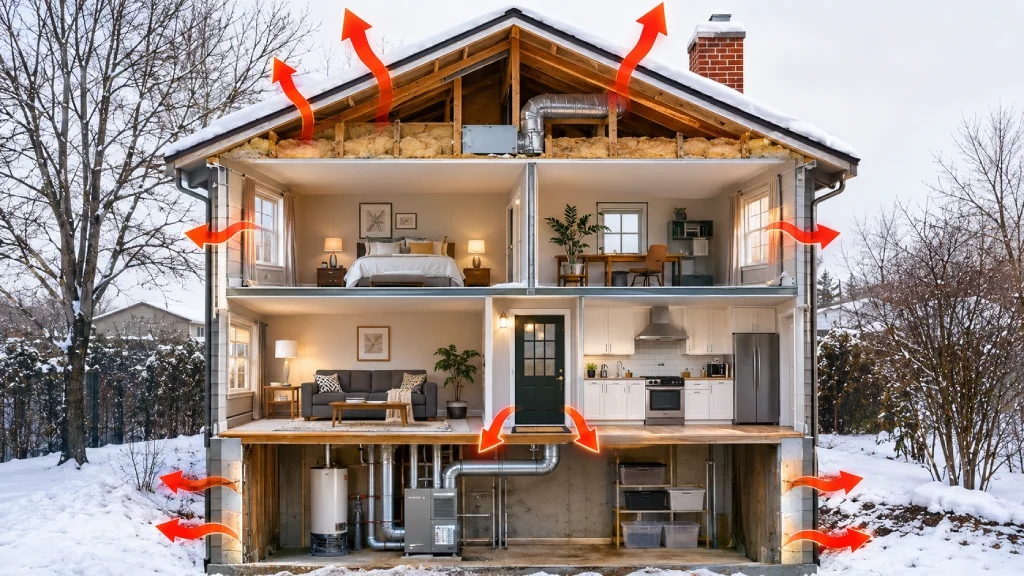
Why these four matter. A furnace can only deliver its rated heat if enough air moves across it and through the ducts. A clogged filter, blocked registers or leaking ducts cut that airflow. Rooms heat unevenly, the furnace runs longer, and it can shut down on its safety limit. Heat also leaves through the walls, attic and basement, so thin insulation and air leaks make the furnace start up more often. Fixing airflow and the building shell first lets the equipment work the way it was designed to.
Water heating is a separate part of your energy use. If that is the bill that worries you, read our guide to a lower water heating bill instead, because this post covers whole-home heating.
Lower Heating Bill Hamilton: Did You Use More Gas or Pay More?
Compare the usage line, not the dollar total. Most gas bills show how much gas you used, usually in cubic metres, and the price per unit separately. Put this winter’s bill next to the same month last winter and look at the cubic metres first.
- Cubic metres about the same, dollars higher: the price or delivery charges changed. Your house did not.
- Cubic metres higher: the weather may have been colder, or the house and furnace are working harder. The nine fixes below apply.
- Cubic metres lower, dollars higher: your fixes are working, but price is hiding the gain.
This one check keeps you from chasing the wrong problem. It also gives you a baseline, so a lower heating bill Hamilton winters allow can be proven in usage rather than guessed.
Which Fix Matches What You Notice?
Match the symptom to the likely cause, then jump to that fix. Several symptoms can share a cause, so treat this as a starting point, not a diagnosis.
| What you notice | Likely cause | Start with |
|---|---|---|
| Furnace runs for long stretches, some rooms stay cold | Dirty filter, blocked vents or leaking ducts | Filter, vents, ducts |
| Cold air near windows and doors | Gaps in seals and trim | Drafts |
| Upstairs or top-floor rooms run colder, attic hatch feels cold | Thin attic insulation or air leaks into the attic | Insulation |
| Dry air, static shocks, house feels cool at a normal setting | Low indoor humidity | Humidity |
| Comfortable rooms but a high bill | House heated while empty or asleep | Thermostat schedule |
| Older furnace, repairs more often, rising usage | Worn equipment losing performance | Tune-up, then upgrade decision |
Lower Heating Bill Hamilton: What Should You Do First?
Work from free to expensive. The cheap fixes also make the expensive ones smaller, because a tighter house needs less heating equipment.
| When | Do this | Why in this order |
|---|---|---|
| This week | 2. Filter, 7. Vents, 3. Thermostat schedule | Free or nearly free, and no tools needed |
| This month | 5. Drafts, 4. Humidity check, 1. Book the tune-up | Low cost, a weekend or one visit |
| Before next winter | 6. Insulation, 8. Duct leaks, then 9. Upgrade decision | Larger jobs that need quotes, and the furnace should be sized after them |
What Are the 9 Ways to Cut Your Winter Energy Costs?
The nine fixes below differ most in who does the work and how long it takes. Cost is relative, comparing the options with each other. It is not a quote.
| Fix | Who does it | Effort | Relative cost |
|---|---|---|---|
| 1. Furnace tune-up | Technician | One visit | Low to medium |
| 2. Change the filter | You | 5 minutes | Low |
| 3. Thermostat setback | You | 15 minutes to set | Free to low |
| 4. Right humidity | You to check, technician to install | Minutes to check | Low to medium |
| 5. Drafts and air sealing | You | A weekend | Low |
| 6. Attic and basement insulation | Contractor | A few days | Medium to high |
| 7. Clear vents and registers | You | 10 minutes | Free |
| 8. Duct leaks | You for visible joints, technician for hidden ones | An afternoon | Low to medium |
| 9. Furnace upgrade | Contractor | Planning plus install | Highest |
1. Does a Furnace Tune-Up Lower the Bill?
A tune-up keeps a working furnace running the way it was built to and catches problems before a cold snap, but it does not turn an old furnace into an efficient one.
Who: technicianEffort: one visitCost: low to medium
A technician cleans and inspects the burners, checks the heat exchanger and venting, tests combustion and safety controls, and confirms airflow. Natural Resources Canada lists yearly furnace servicing among its tips for staying cozy without turning up the heat.
Book before the coldest weeks, when schedules fill. A tune-up is a quiet but real part of a lower heating bill Hamilton homeowners can measure, because it keeps the furnace running as designed. Our furnace tune-up guide explains what a visit covers, and the annual maintenance page shows how to book one.
2. How Often Should You Change the Furnace Filter?
Follow your furnace manufacturer’s schedule, and check the filter’s actual condition at least monthly in heating season. Natural Resources Canada says to follow the owner’s manual and to replace a filter that has been in place for more than three months.
Who: youEffort: 5 minutesCost: low
A clogged filter restricts airflow, so the furnace works harder to move the same heat. Pull the filter out and look at it. A visible layer of dust, a grey colour or matted fibres means it is due. Holding it up to a light is only a rough guide, because a loaded filter can still pass some light and thicker media filters may not show light at all. The manufacturer’s recommendation and the filter’s real condition come first.
Use the size and type your furnace manual lists. A denser filter is not always better, because some furnaces cope poorly with the extra resistance. Ask a technician before you upgrade the filter type.
3. What Should the Thermostat Be Set to in Winter?
Natural Resources Canada suggests about 20°C when you are home and awake and 17°C when you are asleep or out. That is a drop of three degrees for the hours when nobody needs the warmth. These settings suit a typical furnace-heated home.
Who: youEffort: 15 minutes to setCost: free to low
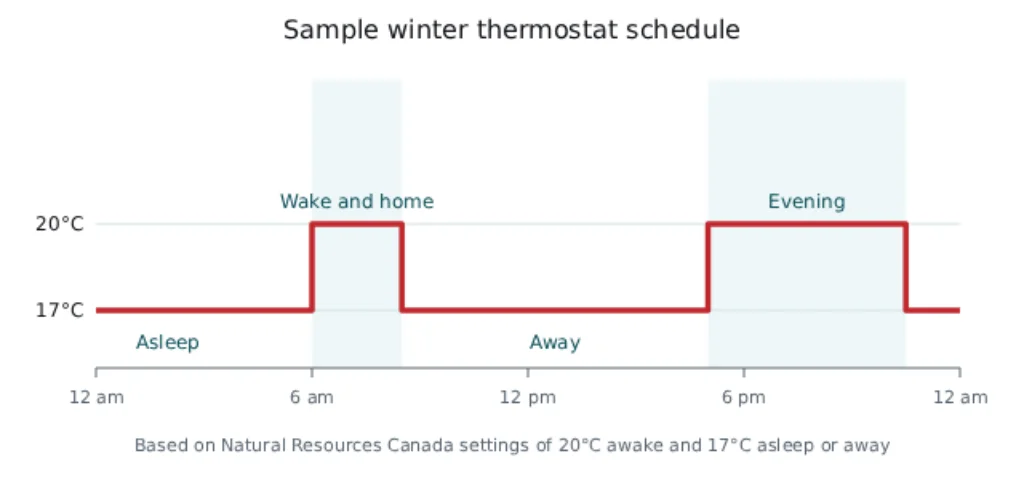
A programmable or smart thermostat runs the schedule for you, which makes it one of the quickest routes to a lower heating bill Hamilton households can set up in an evening. Natural Resources Canada says ENERGY STAR certified smart thermostats are independently certified to deliver energy savings, but it gives no percentage. Read our smart thermostat guide to choose one, then judge the result in cubic metres.
Two cautions. In a deep cold snap, keep the house warm enough that pipes on exterior walls stay safe. If you have a heat pump, the right setback depends on the equipment and how its backup heating is set up. A deep setback can make the backup heat run to recover, which can cancel the saving, so ask your installer for a schedule that suits your system.
4. Does Humidity Change How Warm the House Feels?
Humidity changes how warm a room feels, not how much fuel the furnace burns, so treat it as a comfort fix that may let you leave the thermostat alone. Dry winter air can feel cooler at the same temperature. Too much moisture causes the opposite problem: water condenses on cold windows and exterior surfaces, and dampness that lasts can lead to mould.
Who: you to check, technician to installEffort: minutes to checkCost: low to medium
Health Canada recommends keeping indoor relative humidity between 30 and 50 percent. Its page on moisture and mould in your home also treats condensation on cold window panes as a sign to bring humidity down. A basic hygrometer shows where you stand. If your windows already show condensation, lowering the humidifier setting is the safer move than adding more moisture.
If the air is dry through the whole house, our whole-home humidifier guide explains the types and what a technician checks. The humidifier options page covers installation. A humidifier needs regular cleaning to stay healthy.
5. Where Are the Drafts and How Do You Seal Them?
On a windy day, hold the back of your hand a few centimetres from window and door edges. Any moving cold air marks a gap to seal. This is the hand test Natural Resources Canada recommends.
Who: youEffort: a weekendCost: low
Sealing drafts is often one of the cheapest steps you can take without a contractor.
- Add weatherstripping to doors and openable windows.
- Caulk gaps around window trim.
- Fit foam gaskets behind switch and outlet plates on exterior walls.
- Seal from the inside first, then deal with the outside.
For a full picture, an EnerGuide home evaluation lists where a specific house leaks. The provincial program in the rebate section below includes air sealing in its bundled option.
Safety note. Furnaces, water heaters and fireplaces need air to burn safely. Never block or seal combustion air openings, vents or flue connections. If you plan more than small gap sealing, have a technician check combustion air and venting first, and keep your carbon monoxide alarms working.
6. Is Attic and Basement Insulation Worth It?
For many older homes it is one of the larger gains, and Natural Resources Canada points to the attic and basement as places where added insulation helps. Results vary with what is already there.
Who: contractorEffort: a few daysCost: medium to high
Look at the attic floor. If the ceiling joists are still clearly visible above the insulation, there may be room to add more, but that is only a rough indicator. Depth, insulation type, air leaks from the rooms below and attic ventilation all matter, so have a qualified contractor or energy assessor look at the attic before you decide. In the basement, the strip where the wall meets the foundation is a common place for leaks and thin coverage.
Insulation is the slower, bigger route to a lower heating bill Hamilton homes can keep for years. Attics also need ventilation, so insulation work should not block soffit vents. Get a written quote and ask how the contractor handles both. Insulation is one of the upgrades the provincial program lists, covered below.
7. Are Blocked Vents and Registers Costing You Heat?
Yes. Furniture, rugs and curtains over a register or return can choke airflow, and Natural Resources Canada says to keep vents, ducts and baseboard heaters clear.
Who: youEffort: 10 minutesCost: free
Walk the house with the furnace running and check that every register moves air. Pull furniture back from supply registers and keep the return grille open.
Do not make a habit of closing registers to save heat in unused rooms. Furnaces are designed for a certain amount of airflow, and closing registers can unbalance the system, raise duct pressure and cause noise or comfort problems. How much adjustment a system tolerates depends on its duct design and blower, so ask a technician to balance the airflow instead of guessing.
8. How Do You Know If Your Ducts Are Leaking Heat?
Rooms that stay cold, dust streaks at seams, and ducts running through unheated spaces with loose joints all point to leaks.
Who: you for visible joints, technician for hiddenEffort: an afternoonCost: low to medium
Check the visible ductwork in the basement with the furnace running. Look for gaps and disconnected sections. Seal joints with duct mastic or foil tape made for ducts, not ordinary cloth tape.
Leaks you cannot see need a technician. Ducts in unheated spaces can also be insulated. If one room never warms up, book a service visit to trace the cause.
9. When Does Replacing the Furnace Lower the Bill?
When the furnace is old, repairs keep coming and its efficiency rating is low, and when you do it after sealing and insulating, so the new unit fits the house you will actually have.
Who: contractorEffort: planning plus installCost: highest
Replace last, not first. A furnace sized for a leaky house may be larger than the sealed, insulated house needs, and an oversized furnace can short cycle and heat unevenly. Ask any contractor for a residential heat-loss calculation to CSA F280, the Canadian standard for determining the required capacity of home heating and cooling equipment, instead of copying the size of the old unit.
Start with the section on furnace efficiency just below, then compare options on our furnace replacement page. If you want electric heating, the heat pump page covers that route.
What Role Does Furnace Efficiency Play?
A furnace’s efficiency rating tells you how much of the gas it burns becomes heat in your home, so it sets a ceiling on what the other fixes can save. Check it first.
The rating is called AFUE, and it is printed on the furnace nameplate along with the model number. Our furnace efficiency guide explains what the numbers mean and how to read yours.
Check this first. A high-efficiency furnace in a leaky house still pays to heat the outdoors. Read the rating, then fix the house, then decide on the furnace.
How Can You Calculate Your Own Furnace Operating Cost?
Use the operating cost calculator to see a monthly and annual estimate of what your furnace costs to run, then compare it with your bill. Run it before you change anything, so your lower heating bill Hamilton plan starts from a real number and you can see how to reduce furnace operating costs.
Furnace operating cost calculator
Estimate your monthly and annual operating cost from the details you enter. Also on the operating cost calculator page.
Preview placeholder. On the live page the shortcode Calculate the estimated monthly operating cost of your furnace with this quick quiz. AFUE = Annual Fuel Utilization Efficiency. Standard furnaces are ~80–85%, high-efficiency models are 95–98%. Better insulation = your furnace works less = lower monthly cost. Colder climates mean your furnace runs far more hours per heating season. Check your gas bill for the rate per cubic metre (m³). Average is around $1.20/m³. Our certified partners can quote a newer high-efficiency furnace that could cut your costs significantly. By submitting this form, you are giving your consent to receive phone calls and text messages from our contractor partners. Important: This is a general estimate for informational purposes only. Your actual operating costs may vary based on thermostat settings, furnace age, local climate, and usage patterns. These are estimates. Get precise quotes from certified contractors — for free.
loads the calculator here.Furnace Operating Cost Calculator
Get Accurate Quotes from Local Pros
Two more tools help once you know the baseline. All three give estimates only and do not replace a technician's assessment.
What would a newer furnace save?
Get a rough estimate of annual savings from a newer furnace, based on the details you enter. Also on the furnace savings calculator page.
Preview placeholder. On the live page the shortcode By submitting this form, you are giving your consent to receive phone calls and text messages from our contractor partners. Get free quotes from certified local contractors and find out the exact cost of upgrading your furnace.
loads the calculator here.Ready to Start Saving?
Repair or replace?
Answer a few questions to see whether repair or replacement looks more sensible. It is a guide, not a diagnosis. Also on the repair or replace quiz page.
Preview placeholder. On the live page the shortcode By submitting this form, you are giving your consent to receive phone calls and text messages from our contractor partners. Connect with certified local HVAC contractors for a no-obligation estimate on repair or replacement.
loads the quiz here.Get a Free Furnace Quote
Are There Rebates for Heating Upgrades in Ontario?
Ontario's Home Renovation Savings program lists rebates for upgrades such as insulation, air sealing, windows and doors, smart thermostats and heat pumps. Save on Energy and Enbridge Gas deliver it, with support from the Ontario government. Rebates can support your winter energy savings in Ontario, but they do not replace the basics above.
At the time of writing, the program page does not list a gas furnace rebate. Amounts, eligibility and steps change, so read the official Home Renovation Savings page before you buy or book work. The page describes a bundled option that starts with a home energy assessment and needs two or more upgrades, plus separate single upgrades that do not need one. It does not say whether the program is open to new applications right now, and equipment rules and amounts can change, so confirm current status before you book any work.
Not sure which listed upgrades suit your house? Ask during your home heating audit.
Does Hamilton's Climate or Housing Change the Order of Fixes?
Slightly. A long heating season means small losses add up, which pushes air sealing, insulation and furnace condition to the front of the list. Older houses tend to leak more air and hold less insulation than newer ones, though every house differs.
Homes across Hamilton, Stoney Creek, Ancaster, Dundas, Waterdown, Glanbrook and Mount Hope were built in different decades, so insulation, air tightness and ductwork vary from street to street. Wind on a cold day also makes drafts easier to find. To reduce heating costs in Hamilton, measure first, check the basement and attic early, and fix in order.
When Should You Call a Qualified HVAC Technician?
Call a qualified technician when the problem points to the furnace, airflow or venting rather than a simple habit or a draft. A few checks are safe for any homeowner. These are not.
- The furnace runs almost constantly, shuts off before the house warms up, or cycles on and off often.
- Some rooms stay cold after the filter is fresh and the registers are clear.
- You plan more than small gap sealing, so combustion air and venting need checking.
- You want registers, dampers or ducts adjusted or changed.
- You are replacing a furnace or adding a heat pump, and need a proper heat-loss calculation and sizing.
What Are the Limits of These Fixes?
They cannot change the weather or the price of gas, and savings differ from house to house, so measure your own before and after instead of expecting a set percentage. Natural Resources Canada's figures describe the average Canadian home, not yours.
- A humidifier improves comfort. It does not cut fuel use by itself.
- Insulation and a new furnace can take years to repay their cost.
- Large changes are best planned after an assessment, not guessed.
If you smell gas, or a carbon monoxide alarm sounds, leave the house and call 911 from outside. Do not troubleshoot it. Our furnace safety checklist covers the warning signs.
For a lower heating bill Hamilton homeowners can rely on, make small fixes in the right order and check each one against the cubic metres on your next bill.
Ready for a plan that fits your house?
Book a home heating audit, or call 905 847-1641. We will go through your furnace, airflow and the fixes in this guide.Book a Home Heating Audit
More guides:Furnace tune-up guide · Smart thermostat guide · Whole-home humidifier guide · Furnace safety checklist · Heating and cooling resources
