

Quick answer Heat pump not heating Hamilton homeowners can usually trace to a simple cause. Check the thermostat mode, the air filter and any snow or ice around the outdoor unit first. If heat is still weak, the cause is likely refrigerant, the reversing valve or the defrost controls, and those need a licensed technician.
A heat pump not heating Hamilton homeowners can often fix themselves usually comes down to a thermostat setting, a dirty filter or snow and ice on the outdoor unit. All three take a few minutes to check, and none needs a tool.
This guide covers seven common causes in the order we suggest you check them. For each one you will see how to spot it, what you can safely do yourself, and when to stop and call. Smell burning or see heavy ice? Skip ahead to when to turn the system off and call. If the system is simply working hard in a cold snap, our guide to how a heat pump performs in Hamilton winters is a better place to start.
Heat Pump Not Heating Hamilton: Match the Symptom to the Likely Cause
For a heat pump not heating Hamilton homeowners can often narrow the cause by symptom. Use this table to jump to the right cause. Several symptoms fit more than one cause, so work down the list in order.
| What you notice | Likely cause | First safe action |
|---|---|---|
| Unit never starts, or the house stays cool | 1. Wrong thermostat mode or settings | Set to heat, raise the setpoint a few degrees, check the display and batteries |
| Weak airflow from the vents | 2. Dirty air filter | Turn the system off, then replace or clean the filter |
| Snow or ice packed around the outdoor unit | 3. Outdoor unit blocked by snow or ice | Switch off at the thermostat, clear loose snow from around (not on) the unit, keep hands and tools away from the fan |
| Thick ice stays after defrost, or defrost never seems to end | 4. Defrost cycle problem | Note how long and how often it happens, do not scrape the ice, call a technician |
| Weak heat, hissing, or ice on the refrigerant lines | 5. Low refrigerant (usually a leak) | Rule out causes 1 to 3, then call a qualified technician |
| Heat pump blowing cold air in heat mode | 6. Reversing valve problem | Confirm the thermostat is set to heat, then call if the air stays cool |
| Fine in mild weather, falls behind on the coldest days, or auxiliary heat not working | 7. Backup heat failing or system too small | Look for the aux heat light, note how far the temperature falls, then call |
Interactive tool
Heat Pump Troubleshooting Wizard
Answer five short questions about what your heat pump is doing, when it happens and when it was last serviced. You give your name, email and city to see the result. It is a general guide based on common symptom patterns, not a diagnosis, so a technician still needs to inspect the system. Answer 5 quick questions about your heat pump symptoms and get a likely diagnosis with recommended next steps. By submitting this form, you are giving your consent to receive phone calls and text messages from our contractor partners. Note: This diagnosis is based on common symptom patterns and is for informational purposes only. A certified HVAC technician should inspect your system for an accurate diagnosis. Connect with certified local contractors who can diagnose and fix your heat pump — for free quotes.
Heat Pump Troubleshooting Wizard
Get a Professional Diagnosis
1. Thermostat on heat?Setpoint a few degrees above room temperature
2. Air filter clean?Airflow at the vents feels strong
3. Outdoor unit clear?No deep snow, no thick ice that stays
4. Wait 15 to 20 minutesLet the system respond to your changesStill cold?
Call a technicianThe order we suggest for a heat pump not heating in Hamilton: three free checks, then a call.
Heat Pump Defrost Cycle: Normal Frost or Outdoor Unit Icing Up?
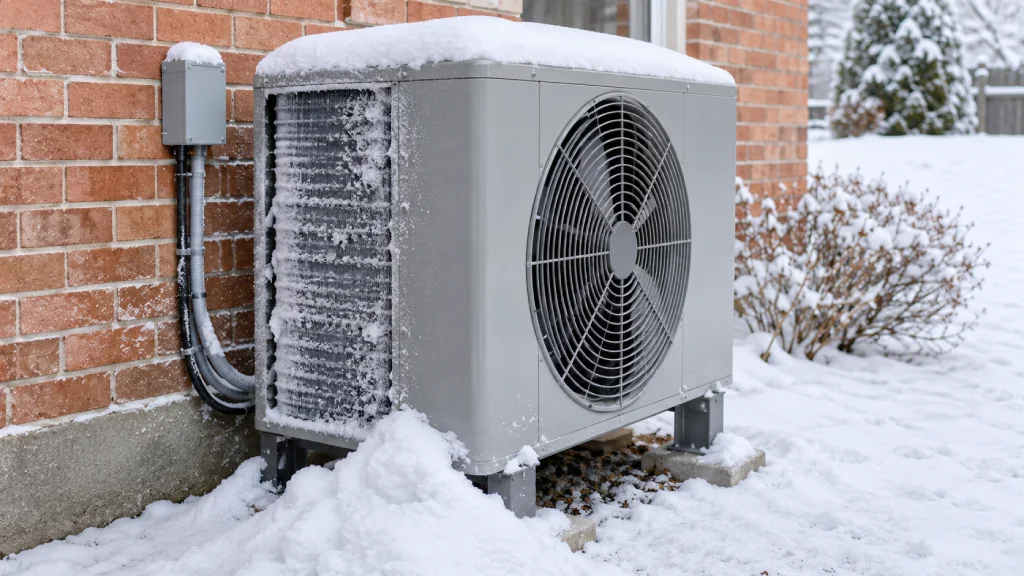
A defrost cycle is normal. In cold, damp weather frost builds on the outdoor coil. The system briefly switches to cooling mode to melt it, and Natural Resources Canada notes that the outdoor fan turns off while it does. You may see steam, hear a whoosh, and feel slightly cooler air indoors for a short time.
Timing varies by model. Lennox says a cycle usually lasts between 5 and 15 minutes. Natural Resources Canada explains that timed systems may start defrost every 30, 60 or 90 minutes, while demand-frost systems start only when they detect frost.
Hamilton winters often sit close to freezing with damp air, which is when frost forms most easily on the coil. Frequent defrost cycles in that weather are routine. A hard cold snap is different, because that is when backup heat and system size start to matter (see cause 7).
Heat pump not heating Hamilton homeowners should worry when the pattern changes: ice that stays after defrost, a cycle that never ends, or cool air indoors for a long stretch. Those signs point to cause 4 below.
The 7 Common Causes of a Heat Pump Not Heating Hamilton Homeowners See
1.Wrong thermostat mode or settings
How to spot it
The display shows cool, off or fan only. The setpoint sits at or below room temperature. A schedule lowered the temperature and has not raised it yet.
Check yourself
Set the mode to heat and raise the setpoint a few degrees above the room. Check the batteries if the screen is blank. Natural Resources Canada advises moderate setbacks of no more than 2°C, because a heat pump recovers slowly and the backup heat may run until it catches up. Our smart thermostat guide explains schedules that suit a heat pump.
Call when
The thermostat is on heat, the screen works, and the outdoor unit still does not start.
2.Dirty air filter
How to spot it
Weak airflow at the vents, dust around the registers, or a filter that looks grey and clogged when you hold it to the light.
Check yourself
Turn the system off, slide the filter out and replace or clean it, depending on the type. Natural Resources Canada recommends changing or cleaning the filter every 3 months. Do it more often in a dusty or pet home.
Call when
Airflow stays weak with a clean filter. Blocked ducts, a failing blower or a frozen indoor coil may be the reason.
3.Outdoor unit blocked by snow or ice
How to spot it
Drifted snow against the cabinet, a snow cap over the top, or a thick sheet of ice over the coil. The fan may sit still or strain. Light frost that clears on its own is normal defrost, not a blockage.
Check yourself
Switch the system off at the thermostat first. Clear loose snow from around the unit by hand or with a soft broom, and keep your hands and tools away from the fan. Follow the clearance in the manufacturer's manual. Do not scrape or chip ice from the coil. Let thick ice melt on its own, or book service.
Call when
Ice keeps coming back, covers the coil or fan, or climbs the refrigerant lines.
4.Defrost cycle problem
How to spot it
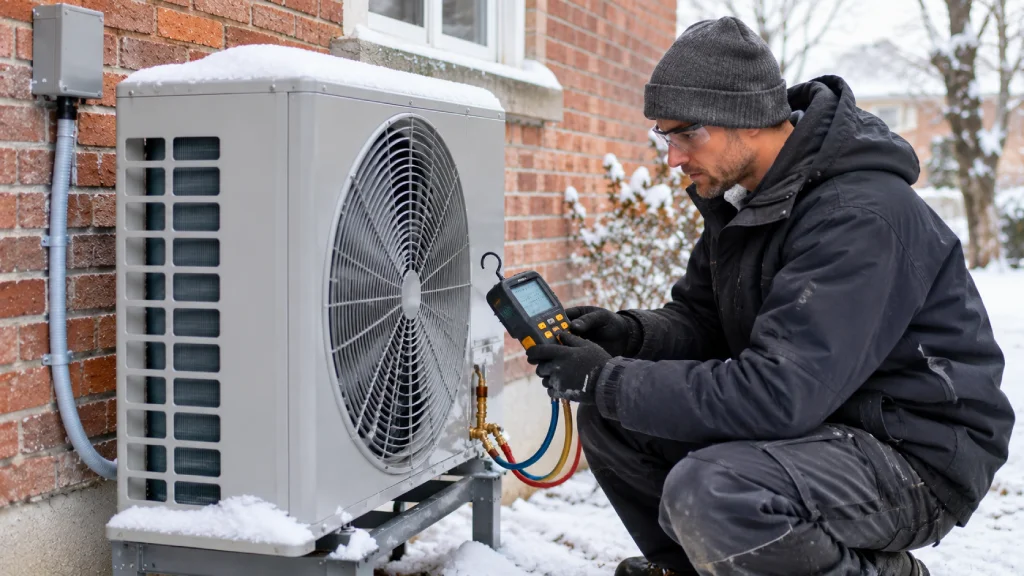
Ice that never clears, a unit that never seems to defrost, or one that stays in defrost with cool air indoors. A short stop of the outdoor fan during a normal cycle is not a fault. Defrost control boards and sensors can fail, and a stuck cycle leaves the house cold.
Check yourself
Watch the outdoor unit for an hour in cold weather and note what it does: how often steam appears and how long the cool air lasts. Do not open the cabinet.
Call when
You see repeated heavy icing or a cycle that runs well past normal. Give the technician your notes.
5.Low refrigerantPro only
How to spot it
The system runs but heats poorly, ice forms on the lines or coil, or you hear hissing. A heat pump does not use up refrigerant, so a low charge points to a leak.
Check yourself
Nothing beyond the first three checks. Do not try to top up refrigerant. Finding and fixing a leak is a different job from adding refrigerant, and both belong to qualified people. In Ontario, you need an Ozone Depletion Prevention (ODP) card to buy and handle refrigerants, and the province says the card alone does not let someone work on or fix refrigeration equipment. Some trades, including refrigeration and air conditioning mechanic, also need a Certificate of Qualification. Ask your contractor what they hold. The Ontario certificate to handle refrigerants page has the details.
Call when
Any of the signs above appear. The technician needs to find the leak, not just add refrigerant.
6.Reversing valve problemPro only
How to spot it
The system is blowing cold air while the thermostat calls for heat, as though it is stuck in cooling mode. You may also hear unusual clicking or whooshing when it should switch modes. The reversing valve is the part that flips the system between heating and cooling, and it also drives defrost.
Check yourself
Confirm the thermostat is set to heat and has not been changed by a schedule or app. That is all you can rule out safely.
Call when
The mode is correct and the air stays cool for more than a normal defrost period.
7.Backup heat failing or a system that is too small
How to spot it
The house is comfortable in mild weather but falls behind on the coldest days. The thermostat may show an aux or emergency heat light (the label varies), or it may never show one even as the house keeps cooling.
Check yourself
On a cold morning, look for the aux heat indicator and note whether the indoor temperature keeps falling. Note the age of the system and whether it kept up in past winters. If you have a gas furnace as backup and it will not start either, see our guide to a furnace that will not turn on.
Call when
Backup heat never switches on, or the system cannot hold temperature even on moderate days. A technician can test the backup heat and check the system against the home's heat loss.
Interactive tool
Heat Pump Size and BTU Calculator
A system that is too small leans on backup heat in cold weather. This tool gives a quick, climate-adjusted starting estimate of BTU and tonnage from your home size, climate zone, insulation and ceiling height. It is an initial estimate only and does not replace a CSA F280 heat-loss calculation by a qualified contractor. By submitting this form, you are giving your consent to receive phone calls and text messages from our contractor partners. A proper Manual J load calculation by a certified HVAC contractor ensures perfect sizing for your home.
Get a Confirmed Size from a Pro
Heat Pump Blowing Cold Air or Just Cooler Than Furnace Air?
A heat pump delivers warm air, not hot air. It moves heat from outside to inside, so the air at the vents often feels milder than the blast from a furnace. That is normal as long as the house reaches the setpoint.
The balance point explains what happens in colder weather. It is the outdoor temperature where the heat pump alone can no longer cover the home's heat loss. Below it, backup heat has to help. Natural Resources Canada says newer air-source models can have minimum operating temperatures somewhere between -15°C and -25°C, so the exact point depends on the model.
Check which system you have. A hybrid system uses a furnace as backup and switches between the heat pump and the furnace, but never runs both at once. An all-electric system uses electric heating elements that can run alongside the heat pump, and they cost more to run than the heat pump itself. Natural Resources Canada describes both in its guide to heating and cooling with a heat pump.
If your home loses heat faster than the system can supply it, backup heat runs often. A heat pump not heating Hamilton houses on the coldest days is often a sizing question, not a fault, which is why cause 7 is on this list. For more on how cold affects output, see our cold-weather heat pump guide.
Outdoor Unit Safety: What to Do and What Not to Do
Switch the system off at the thermostat before you go near the outdoor unit. Then keep to these rules whenever you inspect a heat pump not heating Hamilton homes depend on for winter heat.
- Do keep hands, tools and clothing away from the fan. Never reach into the cabinet while the unit is on.
- Do follow the manufacturer's clearance requirements for snow, plants and fences. They are in the installation manual.
- Do let thick ice melt naturally, or arrange professional service.
- Do not scrape, chip or pry ice off the coil. You can puncture it, and a damaged coil turns a small problem into a costly one.
- Do not open the electrical panel or any refrigerant compartment, and do not touch the refrigerant lines.
- Do not pour hot water on the unit. It refreezes and adds to the ice.
- Do not run a gas or fuel-burning heater indoors to make up the difference. Use the backup heat you already have or a safe electric space heater.
| Normal defrost-related frost | Persistent heavy icing |
|---|---|
| Light frost or steam on the outdoor unit | Thick ice over the coil, fan guard or refrigerant lines |
| Fan stops for a short time, then restarts | Ice is still there after a defrost cycle, or keeps returning |
| Slightly cooler air indoors for a few minutes | The house keeps cooling and the air stays cool |
| Nothing to do | Switch off at the thermostat and call |
Heat Pump Not Heating Hamilton: When to Turn It Off and Call
Turn the system off at the thermostat and call right away if you notice:
- A burning smell from the vents or the outdoor unit
- A breaker that trips repeatedly when the system starts
- An outdoor unit covered in ice
- Grinding, banging or other loud noises from the outdoor unit
If the house is getting too cold, use a safe backup heat source while you wait. If a carbon monoxide alarm sounds in a home with a gas furnace as backup, leave the house and call 911 from outside. The Ontario guide to carbon monoxide safety covers the steps.
Checked the basics and still cold? A technician can test the system and tell you what is wrong. See our heat pump services in Hamilton or book a check-up.Book a heat pump check-up
What Affects the Cost of Heat Pump Service?
The cost depends on what is wrong, so a diagnosis comes first. We cannot give a fair price for a heat pump not heating Hamilton homeowners call us about without seeing the system. These factors move the total most.
- The part involved. A control board or sensor is a different job from a reversing valve or compressor.
- Refrigerant leaks. Cost depends on where the leak is, how hard it is to reach and how much the system lost.
- System age and warranty. Parts or labour may be covered, so find your paperwork first.
- Access. An outdoor unit that is hard to reach can add time.
- Repair or replace. On an older system, a technician may help you weigh a repair against replacement.
Ask for a written estimate that separates diagnosis, parts and labour. Running costs are a separate question from service costs, and the tool below estimates those.
Interactive tool
Heat Pump Operating Cost Calculator
Estimate monthly and yearly heating and cooling costs from your system's efficiency (COP and SEER), home size, insulation, region and electricity rate. Results are a general estimate. Actual costs depend on usage, weather, thermostat settings and equipment age. Calculate the estimated monthly operating cost of your heat pump for heating or cooling with this quick quiz. COP (Coefficient of Performance) measures heating efficiency. Higher = more efficient. Check your manual or use the default. SEER (Seasonal Energy Efficiency Ratio) measures cooling efficiency. Higher = more efficient. Check your electricity bill or use the Canadian average. By submitting this form, you are giving your consent to receive phone calls and text messages from our contractor partners. IMPORTANT: This is a general estimate for informational purposes only. Actual costs vary based on usage patterns, local weather, thermostat settings, and equipment age. These are estimates. Get precise quotes from certified contractors — for free.
Heat Pump Operating Cost Calculator
Get Accurate Quotes from Local Pros
What Should You Tell the Technician?
Specific details shorten the visit. Before you call about your heat pump not heating Hamilton technicians will want the same few facts, so jot them down.
- What the thermostat is set to, and what the room temperature reads
- When the problem started and the outdoor temperature at the time
- Whether the outdoor fan runs, and whether you see ice or steam
- What the air from the vents feels like, and whether it changes over time
- Any error codes, lights or sounds, plus the age of the system and whether it is hybrid or all-electric
How Can You Prevent Winter Heat Pump Problems?
A few small habits catch most problems early.
- Change or clean the filter every 3 months, as Natural Resources Canada recommends.
- Book annual maintenance with a qualified contractor.
- Keep vents and registers free of furniture and carpeting so air can move.
- Before winter, clear leaves and debris from around the outdoor unit and keep the manufacturer's clearance.
- Use moderate thermostat setbacks of no more than 2°C, or a smart thermostat that starts the system early.
Heat Pump Not Heating Hamilton: Troubleshooting Questions Answered
Most often it is a normal defrost cycle, a thermostat set to cool or fan only, or air that simply feels cooler than furnace air. If it stays cool well past a normal defrost, the cause may be the reversing valve, an iced coil or low refrigerant. Call a technician.
Only if the ice is thick. Light frost that clears during defrost is normal. If ice covers the coil or fan, or keeps returning, switch the system off at the thermostat, do not chip the ice, and let it melt or call a technician.
Lennox says a cycle usually lasts 5 to 15 minutes, and timing varies by model. Natural Resources Canada does not give a duration. If defrost runs much longer than your system’s normal pattern, or ice stays afterwards, have it checked.
Longer, steadier running is often normal in cold weather. If the house stays cold, look for a dirty filter, an iced coil, a recent large setback, low refrigerant or a system that is too small. Check the basics first, then call if it still does not warm up.
Emergency heat is a thermostat setting that runs only the backup heat and bypasses the heat pump. Use it as a short-term measure when the heat pump is not working, while you wait for service. Settings vary by model, and hybrid systems may not have one, so check your manual.
Yes, depending on the model and its size. Natural Resources Canada says newer air-source models can have minimum operating temperatures between -15°C and -25°C, with backup heat helping below that. If your home struggles in a cold snap, ask a technician about system size and backup heat.
Want a technician to look at it? A heat pump check-up starts with finding out what is wrong, before any work begins.Book a heat pump check-up
Keep Reading
Heat pumps in Hamilton wintersHow performance changes in the cold
Smart thermostat guide
Schedules that suit a heat pump
Furnace will not turn onQuick checks for the backup side
Heating and cooling resourcesAll our guides in one place
