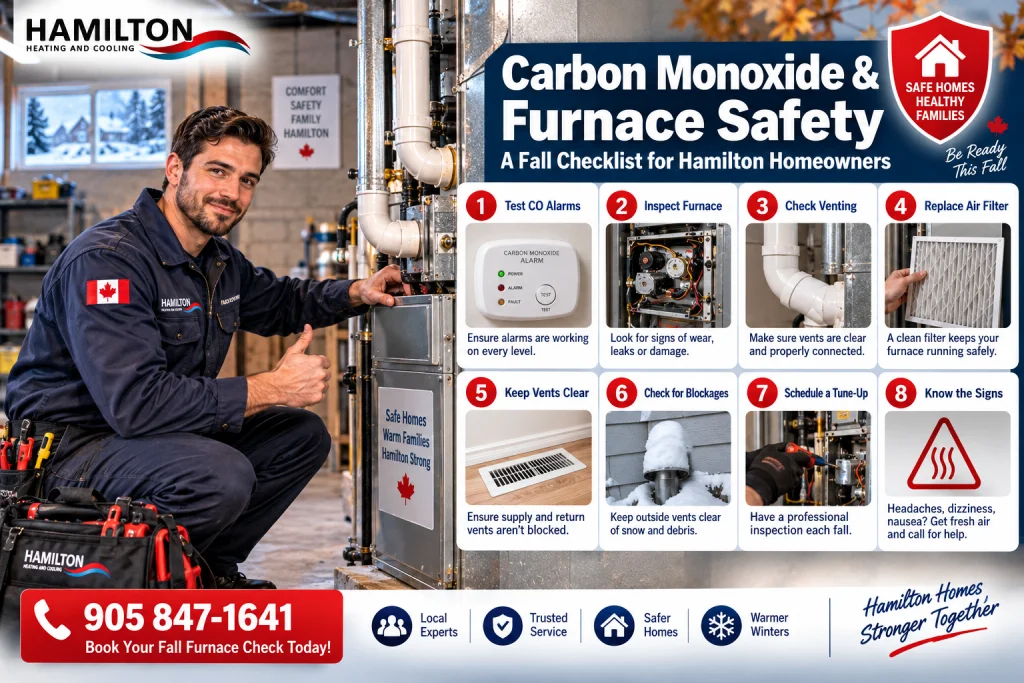
If your furnace hasn’t run since March, the first full heating cycle of the season is exactly when carbon monoxide (CO) risks are highest. A proper furnace safety checklist catches the two failures that cause most Hamilton CO incidents: a venting problem that developed over summer, and a CO alarm that quietly died months ago. This guide walks homeowners and technicians through both, covers what changed under Ontario’s fire code as of January 1, 2026, and goes deeper into the mechanics behind backdrafting, heat exchanger failure, and CO alarm selection than a standard checklist usually does.
This guide helps two audiences: Hamilton homeowners who want to complete their own furnace safety Hamilton walkthrough before the heating season starts, and HVAC contractors who need a fall inspection checklist that meets code requirements. Jump to the section that applies, or read straight through — the sequence follows the order we actually work through on a fall service call.
Why does carbon monoxide risk spike when Hamilton furnaces restart for fall?
A furnace that sat idle all summer is more likely to backdraft or misfire on its first few cycles than at any other point in the year. Dust settles in the burner assembly, rodents occasionally nest near intake vents, and small cracks in flue pipe joints go unnoticed until combustion gases start flowing through them again.
The “first cycle” pattern we see every October
Call volume for “burning smell” and “gas smell” complaints jumps in the first two weeks of sustained furnace use, every year, without fail. Most of these are dust burning off the heat exchanger, which clears within an hour and is harmless. A smaller number are genuine venting or combustion problems that only show up once the appliance is under real load rather than a five-minute test cycle. The checklist below helps you distinguish between the two before you have to guess.
What’s different about Hamilton’s older housing stock
Hamilton’s older housing stock shapes many furnace safety issues. Many homes in Hamilton’s lower city and older Mountain neighbourhoods date to before 1980 and use masonry chimneys designed for natural-draft appliances. Builders sized those chimneys for the furnaces and water heaters common at the time.
Decades of renovations, including new windows, added insulation, and higher-efficiency furnace replacements, have since changed the pressure and draft conditions those chimneys must handle.
This matters more here than it would in a newer subdivision, and it’s the reason two of the checks further down (orphaned water heater venting and negative pressure testing) are worth taking seriously in this market specifically.
The complete fall furnace safety checklist for Hamilton homeowners
Work through these before you rely on the furnace overnight for the first time. Most take under five minutes each.
Before you turn the furnace on for the season
- Test every CO alarm’s function button and confirm the unit is within its manufacturer expiry date, usually printed on the back (typically 7–10 years from manufacture).
- Replace CO alarm batteries even in hardwired units with battery backup — a dead backup battery means the alarm goes silent in a power outage.
- Confirm you have a CO alarm on every storey of the home, not just outside bedrooms — this is the part of the 2026 code change homeowners miss most often (details below).
- Walk the exterior venting termination and clear leaves, wasp nests, or debris from the intake and exhaust pipes.
- Replace the furnace filter before the first extended run — a clogged filter restricts airflow and can contribute to overheating and short-cycling.
- Check that nothing is stored against the furnace or blocking the cold air return; combustion appliances need clear airflow to draw properly.
During the first week of regular use
- Look for soot, staining, or rust around the furnace cabinet, flue connector, and draft hood after the first few cycles.
- Listen for a metallic ticking or popping sound a few minutes after the furnace shuts off — see the heat exchanger section below.
- Test the thermostat through a full heat cycle and confirm the furnace ignites cleanly, without repeated clicking or delayed ignition.
- Track any lingering odor past the first hour of the very first run — a brief dusty smell is normal, a persistent or sharp one is not.
- Note whether bathroom fans, a range hood, or a clothes dryer running at the same time as the furnace seem to change how it sounds or draws — a sign of the negative pressure issue covered further down.
- Book an annual inspection with a licensed technician if it’s been more than 12 months since the last one — several of the checks above and below require combustion analysis equipment a homeowner won’t have.
For a deeper walkthrough of what’s involved in that annual visit, our HVAC inspection cost guide breaks down what a technician actually checks and what it typically runs. Our furnace maintenance tips post covers the routine upkeep side of this in more detail, and if your furnace is already showing wear beyond routine maintenance, our common furnace repairs guide covers the issues that show up most in Hamilton homes this time of year.
Where should CO alarms go under Ontario’s current fire code?
As of January 1, 2026, Ontario Fire Code changes require a CO alarm on every storey of a home with a fuel-burning appliance, fireplace, or attached garage — not only outside sleeping areas as the previous rule required. This closes a real gap: a slow CO leak in a basement furnace room used to go undetected until it reached the upper-floor alarm.
| Location | Why it matters | 2026 code status |
|---|---|---|
| Outside each sleeping area | Alerts occupants while they’re most vulnerable to CO’s flu-like symptoms going unnoticed | Required (unchanged from 2014 rule) |
| Main floor | Catches leaks from kitchen gas appliances or an attached garage even without a bedroom on that level | Newly required for every storey |
| Basement / furnace room level | Closest point to the furnace, water heater, and any gas fireplace insert — often the first area affected | Newly required for every storey |
| Adjacent to an attached garage | Idling vehicles and gas-powered equipment are a common CO source separate from the furnace itself | Required where an attached garage is present |
For official confirmation of the requirement and where it applies to your specific home type, the Technical Standards and Safety Authority’s fire code summary is the primary source. For what CO exposure actually does to the body at different concentrations, Health Canada maintains a plain-language carbon monoxide symptoms reference worth bookmarking.
Battery-only, plug-in, combo, or smart alarm — which fits your home?
Meeting the code requirement is the floor, not the ceiling. The type of alarm you install in each location matters almost as much as the location itself.
| Type | Best for | Watch out for |
|---|---|---|
| Battery-only | Renovated spaces with no nearby outlet | Highest failure rate in humid basements; needs disciplined annual battery replacement |
| Plug-in with battery backup | Furnace rooms and basements near an outlet | Still needs the backup battery checked — it’s easy to forget since the unit “looks” powered |
| Combination smoke/CO alarm | Bedrooms and main living areas, one device instead of two | Slightly shorter service life than standalone CO units in some models — check the expiry date separately |
| Smart, app-connected alarm | Homes where you want a phone alert while away, rental properties | Still needs a physical backup power source; a Wi-Fi outage shouldn’t mean no alarm |
One practical note from the field: battery-only CO alarms in unfinished Hamilton basements fail more often than the ones upstairs, mainly because of humidity and dust around the furnace room. If you’re adding an alarm to comply with the new basement requirement, a plug-in unit with battery backup tends to hold up better in that environment than a battery-only model.
How does backdrafting actually happen?
Backdrafting is when combustion gases flow backward down the flue and into the living space instead of exiting outside, usually because something is pulling more air out of the house than the chimney can pull in to replace it. It’s the mechanism behind most non-mechanical CO incidents, and understanding it makes the rest of this checklist make more sense.
Common causes in Hamilton homes specifically
- Exhaust fans competing for air. A range hood, bathroom fan, and clothes dryer running at once can depressurize a tightly sealed house enough to overpower a natural-draft chimney’s ability to exhaust properly.
- An oversized chimney serving an “orphaned” appliance. When a furnace is upgraded to a high-efficiency, sidewall-vented model, a water heater that used to share that chimney is often left venting alone into a flue sized for two appliances — see the contractor section below for what this actually looks like on an inspection.
- Home tightening without a matching fresh-air strategy. New windows and added insulation reduce natural air infiltration, which is good for energy bills but changes the pressure balance a natural-draft appliance depends on.
- Blocked or restricted venting. Bird nests, ice buildup, or debris in an exterior termination point restrict the path gases need to exit, forcing them to find another way out.
If your home has had recent window, insulation, or exhaust fan upgrades and still relies on a natural-draft furnace or water heater, that combination is worth mentioning specifically when you book a fall inspection — it changes what the technician tests for.
What are the early warning signs of a cracked heat exchanger?
A cracked heat exchanger is the single most dangerous furnace fault because it lets combustion gases, including CO, mix directly into the air your ductwork circulates through the house. It’s also one of the harder faults to catch without instruments, which is why it deserves its own section.
- A ticking or popping sound after the burner shuts off — not during operation — as the metal cools and a crack expands and contracts. This is often the very first sign, and it’s easy to dismiss as normal furnace noise.
- A faint, sharp odor resembling formaldehyde during the heating cycle, distinct from the dusty smell of a first fall start-up.
- Soot buildup around the burner compartment or on the inside of the cabinet door.
- The flame appears to flicker or lift when the blower fan turns on, which can indicate pressure changes escaping through a crack.
- Unexplained headaches or drowsiness that ease when you leave the house and return when you’re back — this is a symptom pattern, not a furnace symptom, but it’s the one that should send you outside immediately.
Why a mirror test isn’t enough anymore
Older inspection guidance recommended holding a mirror near the heat exchanger and watching for fogging or flame movement as a rough visual test. It’s still sometimes used as a quick first pass, but it misses hairline cracks that only open under thermal expansion during a full heat cycle, and it can’t quantify how much CO is actually crossing into the air stream.
How a combustion analyzer actually confirms a crack
A combustion analyzer measures CO concentration in the supply air separately from the return air while the furnace runs a full cycle. A meaningful CO differential between the two — supply air reading higher than return air — indicates combustion gases are crossing into the circulated air somewhere in the heat exchanger, even if nothing is visible to the eye. This is the test that actually confirms or rules out a crack, rather than just suggesting one.
If you’re weighing whether an aging furnace is worth repairing at all once a technician flags this kind of issue, our furnace replacement cost guide and the furnace repair-or-replace quiz can help frame that decision alongside the safety question.
DIY checks vs. professional inspection: where’s the line?
Everything a homeowner can safely check is visual, functional, or involves no disassembly of gas or electrical components. Combustion safety testing requires equipment and training that goes beyond a checklist.
| Safe for a homeowner to check | Requires a licensed technician |
|---|---|
| Testing CO and smoke alarm function buttons | Combustion analysis (CO, CO2, O2 levels in flue gas) |
| Replacing the furnace filter | Draft and spillage testing at the draft hood |
| Clearing exterior vent terminations of debris | Heat exchanger inspection with a borescope or combustion analyzer |
| Listening for unusual sounds after shutoff | Gas pressure and manifold adjustment |
| Checking for visible soot or staining | Ambient CO testing in the furnace room and living spaces |
| Confirming clear airflow around the unit | Negative pressure and depressurization testing |
If any homeowner-level check turns up something in the right-hand column’s territory — soot, an odd smell, a sound after shutoff — that’s the point to stop and book a visit rather than keep troubleshooting. Our furnace repair team handles exactly this kind of diagnostic work across Hamilton, and the furnace troubleshooting wizard is a good first stop if you’re not sure whether what you’re seeing is urgent.
What should Hamilton HVAC contractors verify during a fall safety inspection?
For technicians running fall safety visits, a few checks matter more in Hamilton’s housing stock specifically than they would in a newer-build market.
The “orphaned water heater” risk
Hamilton has a large inventory of pre-1990 homes where the furnace and a natural-draft water heater originally shared a masonry chimney. When that furnace gets replaced with a high-efficiency, sidewall-vented unit — see our furnace installation page for what that swap involves — the water heater is left venting alone into a chimney it was never sized for on its own. That mismatch is a classic setup for backdrafting and spillage that has nothing to do with the furnace itself. Any fall inspection following a furnace replacement should include a spillage test on the water heater draft hood, not just the furnace.
Negative pressure from home tightening
Renovated Hamilton homes with new windows, added insulation, or a newly installed range hood or bathroom exhaust fan can pull the house into negative pressure relative to outside, which competes with a natural-draft appliance’s ability to exhaust properly. A pressure differential test between the furnace room and outdoors is worth the extra ten minutes on any home with recent renovation work.
Combustion analysis and documentation standards
Combustion analysis should follow CSA B149.1 guidance for gas appliances, and any technician performing this work in Ontario should carry current TSSA registration homeowners can verify a contractor through TSSA’s registered fuels contractor search before booking. Documented CO differential readings, draft measurements, and spillage test results give both the homeowner and the contractor a record if a warranty or insurance question comes up later, and they’re the difference between “we checked it” and being able to show exactly what was measured.
Common furnace safety misconceptions
A few beliefs come up often enough on service calls that they’re worth addressing directly.
| Misconception | What’s actually true |
|---|---|
| “A smoke detector will catch a CO leak too.” | Smoke and CO are detected by different sensor technology; a smoke-only alarm will not sound for a CO leak. You need a dedicated CO sensor, whether standalone or combined. |
| “New furnaces don’t need CO alarms nearby.” | High-efficiency furnaces can still malfunction, and the code requirement is based on having a fuel-burning appliance in the home at all, not on its age or efficiency rating. |
| “If there’s no smell, there’s no CO.” | Carbon monoxide is colourless and odourless. Any smell you notice during a furnace fault comes from something else burning off, not the CO itself. |
| “An annual furnace tune-up isn’t necessary if it’s running fine.” | Combustion problems and early heat exchanger cracks often produce no audible or visible symptoms until they’re well established. Annual testing catches what running “fine” can hide. |
| “CO alarms don’t expire, only the batteries do.” | The sensor itself has a service life, typically 7–10 years, independent of the battery. An alarm past its expiry date can fail to detect CO even with a fresh battery installed. |
What should you do if your CO alarm goes off?
Get everyone, including pets, outside into fresh air immediately, then call 911 from outside the home. Don’t stop to open windows, find the source, or investigate the furnace first.
- Leave the house and move to fresh air right away — don’t linger to search for the cause.
- Call 911 or your local fire department once you’re outside.
- Do not re-enter until fire services or a qualified technician confirms it’s safe.
- If anyone shows symptoms — headache, dizziness, nausea, confusion — mention this to the 911 dispatcher, since it changes the response.
- Once cleared, have the furnace and any other fuel-burning appliances inspected before using them again.
Frequently asked questions
How often should I test a CO alarm?
Press the test button monthly and replace batteries at least once a year, ideally when you change your furnace filter so the two become one habit.
Can a furnace produce carbon monoxide without any visible cracks or damage?
Yes. A dirty burner, a clogged flue, or a venting problem can all produce elevated CO even in a furnace with an intact heat exchanger, which is why combustion testing checks the gas itself rather than relying on a visual inspection alone.
Is it normal to smell something when the furnace runs for the first time in fall?
A mild dusty smell for the first hour of operation is normal and comes from dust burning off the heat exchanger. A sharp, sour, or persistent odor beyond the first cycle is not, and is worth a same-day inspection.
Do I need a CO alarm if I don’t have gas appliances?
If your home has an attached garage, a fireplace, or receives heated air from any fuel-burning appliance, you’re covered by the 2026 requirement regardless of whether your furnace itself is gas, oil, or propane.
Why would my water heater be at risk if only my furnace was replaced?
If the two appliances originally shared a chimney, replacing the furnace with a sidewall-vented model can leave the water heater venting alone into a flue sized for both appliances, which can affect its draft. This is worth asking about specifically when a furnace installation is scheduled.
How long does a furnace safety inspection take?
A thorough fall safety visit, including combustion analysis and a heat exchanger check, typically runs 45–75 minutes depending on furnace age and accessibility.
Getting your furnace ready for the season ahead
Most of this checklist takes less than half an hour, and the parts that matter most CO alarm coverage and a functioning heat exchanger are the two things worth never guessing about. If you want a second opinion before your furnace runs overnight for the first time this fall, our furnace cost calculator and troubleshooting wizard are both free starting points, and our team is a quick call away for a full inspection through our contact page if anything on this list raises a flag.
For broader seasonal prep beyond the furnace itself, see our guides on preparing your HVAC system for Canada’s changing seasons and year-round HVAC maintenance, our furnace repairs overview if something on this checklist points to a bigger issue, and if indoor air quality is on your mind alongside safety, our indoor air quality tips guide and air treatment systems page cover what to look at next.