

Yes, for particles, if the system suits your ductwork and the furnace fan runs. A whole-house air purifier or higher-rated filter can cut dust, pollen, pet dander and smoke particles. It does much less for odours and gases, and it cannot fix an active moisture or mould problem.
Do whole house air purifiers work well enough to justify the cost? This guide is for Hamilton homeowners weighing a whole-home system against a portable unit or a better furnace filter. You will see what each option can and cannot do, who tends to benefit, and five signs it is worth acting.
Not sure which setup fits your house?
A technician can check your filter, ducts and blower before you spend on equipment.
Which problem are you trying to solve?
Match what you notice to the most likely cause before you shop. Many air quality complaints are really moisture, odour or filter problems, and those need a different fix.
| What you notice | Most likely cause | What usually helps first | Does a whole-house system help? |
|---|---|---|---|
| Dust returns within days of cleaning | Overdue filter, leaky ducts, fine particles recirculating | Check the filter, then have the ducts inspected | Often, once the filter and ducts are sorted |
| Sneezing or congestion indoors, pets roam the house | Dander and pollen moving through the system | A better furnace filter, regular vacuuming, a portable HEPA unit in the bedroom | Yes for particles, though results vary by person |
| Musty smell or a damp basement | Moisture and mould growth | Find and fix the moisture, then control humidity | No. It does not remove the cause |
| Cooking, paint or cleaning odours linger | Gases and volatile organic compounds (VOCs) | Ventilation and removing the source | Limited. Depends on how much carbon media is used |
| Hazy outdoor air from smoke | Fine particles from outside | A good filter with the fan running, plus a portable HEPA unit in one room | Yes for particles |
| Dry air and static in winter | Low humidity | A humidifier. See humidifier options for Hamilton homes | No. It is a different job |
Do whole house air purifiers work for particles, gases, or both?
They work well on particles and poorly on gases, and only while air is moving through them. Fine particles such as dust, pollen, pet dander and smoke are what mechanical filtration is built to catch. The U.S. EPA states in its guide to air cleaners in the home that filters and air cleaners can reduce indoor pollution but cannot remove everything, and that most are designed for either particles or gases.
Two practical limits decide how well a ducted system performs in a real house:
- Fan run time. The EPA notes that a typical home HVAC system runs less than a quarter of the time in heating and cooling seasons, and that filters work only while it is running. More run time means more filtering, but also higher electricity use and, in summer, potentially less reliable humidity control.
- Fit with your system. Every filter adds resistance to airflow. A system matched to your blower and ducts keeps air moving. A mismatched one can starve the blower and cut comfort.
On health, the evidence is modest. The EPA says studies, mostly of portable HEPA cleaners, show possible small improvements in allergy and asthma symptoms, which are not always noticeable to the person. Treat any purifier as one layer in a plan, and talk to your doctor about managing asthma or allergies.
How does a whole-house air purifier work with your furnace?
It sits in or beside your ductwork and treats air each time the furnace or AC blower moves it. Return air from your rooms passes through the filter or purifier, the blower pushes it through the supply ducts, and the loop repeats.
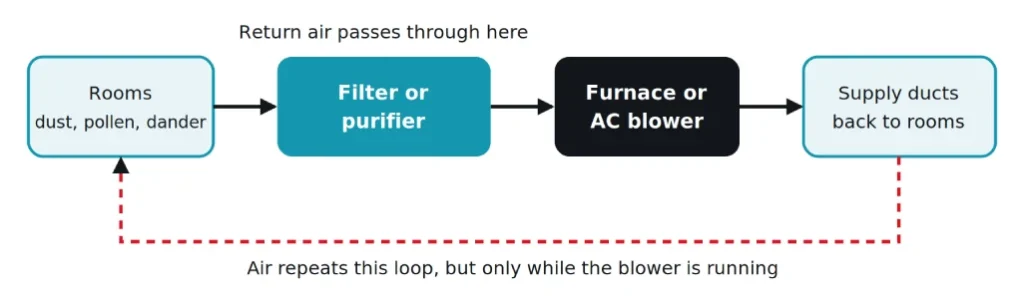
How a whole-house air purifier cleans air through the furnace fan Air leaves the rooms through the return duct, passes through the filter or purifier, is moved by the furnace blower, and returns to the rooms through the supply ducts. Cleaning only happens while the blower is running. Rooms (dust, pollen, dander) Filter or purifier Furnace or AC blower Supply ducts back to rooms Air repeats this loop, but only while the blower is running Return air passes through here Diagram: how a whole-house air purifier cleans air through the furnace fan. Cleaning happens only while the blower runs.
Systems vary. Some are a deeper media filter cabinet, some add an activated carbon stage for odours, and some use electronic cells or ultraviolet lamps. Hamilton Heating and Cooling’s air purification systems page describes a three-stage setup with a pre-filter, a HEPA stage and a carbon stage that connects to the furnace and air conditioner.
Ask for airflow to be measured, not assumed. A sound approach is to have the installer record static pressure before and after, so you can see what the equipment does to the blower’s workload.
Avoid devices that make ozone on purpose. Health Canada and the EPA both advise against ozone-producing air cleaners, because ozone irritates the lungs. The EPA adds that some electrostatic, ionizing and plasma units, and ultraviolet lamps without proper coatings, can emit ozone as a by-product, and points to the California Air Resources Board and AHAM lists of tested models.
HVAC air purifier vs portable: which setup fits?
A better furnace filter is the cheapest first step, a portable HEPA unit is the strongest single-room fix, and a ducted system makes sense when you want every room covered without moving machines around.
| Option | Strength | Limits | Coverage | Upkeep |
|---|---|---|---|---|
| Higher-rated furnace filter (MERV upgrade) | Lowest cost. Works with your existing system | Works only while the blower runs. Your blower and filter slot set the ceiling | Whole house | Check monthly in heating season. Replace when dirty |
| Whole-house air purifier (ducted) | Treats every room. No units to place or move | Needs compatible ducts and fan time. Limited on gases. Higher install cost | Whole house | Media or cells replaced on the maker’s schedule |
| Portable HEPA air cleaner | Strong on fine particles in the room it is sized for | One room at a time, doors closed. Noisier at high speed | Single room | Filter changes plus running cost |
Health Canada’s advice on portable air cleaners says to size the unit to the room using its clean air delivery rate (CADR), and notes that there are no widely used performance ratings for filters that claim to remove gases. That second point applies to ducted carbon stages too.
What is a MERV rating, and is higher always better?
MERV is a 1 to 20 scale, developed by ASHRAE, for how well a duct filter catches particles. Higher traps more, but also resists airflow more. The EPA suggests MERV 13 or as high as your fan and filter slot can handle, and says filters at MERV 13 and above must show at least 50% removal of the smallest particles tested. It also says most furnaces and HVAC systems can take MERV 13 if the filter is replaced often, and that a technician can confirm what yours can use.
Hamilton Heating and Cooling’s furnace maintenance tips take a more cautious line, advising against MERV 13 and above unless the furnace is rated for it. The two positions fit together: go as high as your system can safely take, and have a technician confirm that limit instead of guessing.
True HEPA is a separate standard, and it usually needs purpose-built housing or its own fan rather than a drop-in filter. If a product advertises HEPA, ask how that performance is achieved in your ducts. The guide to telling true HEPA from HEPA-style labels covers the wording to look for.
Do I need an air purifier in Hamilton, and who benefits?
You are most likely to notice a difference if particles are your trigger and you spend much of the day indoors. You are least likely to if your issue is moisture, odour or dry air.
More likely to notice a difference
- Pets that shed and roam the whole house
- Pollen allergies with symptoms that are worse indoors in spring and early summer
- Household members with asthma, where a doctor has linked symptoms to airborne triggers
- Smoke from outdoors, a wood-burning appliance, or renovation dust
- Homes where several rooms matter, not just one bedroom
Less likely to notice a difference
- Ordinary dust that clears with a fresh filter and regular vacuuming
- A musty basement or visible mould, which points to moisture
- Cooking or cleaning odours, where ventilation does more
- Dry winter air and static
- Worry about carbon monoxide, which needs working alarms and furnace service
If asthma is part of the picture, a purifier is a supplement to medical advice, not a replacement for it.
What can a whole-house air purifier not do?
It will not remove a moisture source, replace fresh air, guard against carbon monoxide, or guarantee symptom relief.
- Mould and musty smells. The EPA states that air cleaners and furnace filters do not address the cause of mould, which is a water or moisture problem. They may remove some mould particles.
- Carbon monoxide. A purifier is not a safety device. Fit working CO alarms and keep up annual service. The carbon monoxide and furnace safety checklist covers the basics.
- Gases and odours. A carbon stage can help only if it holds enough carbon media, and no widely used rating shows how well it performs.
- Unknowns. How much a given system will lower particle levels in your particular house is hard to predict without measurement.
What role do ventilation and humidity play?
Removing the source and bringing in fresh air come ahead of filtration, and humidity decides whether mould and dust mites get a foothold. Health Canada says the best ways to improve indoor air are to remove contaminant sources and ventilate with clean outdoor air. Check the Air Quality Health Index before opening windows on smoky or hazy days.
For humidity, Health Canada’s mould guidance recommends keeping relative humidity between 30% and 50%, fixing leaks promptly, and using a dehumidifier or air conditioner when needed. Hamilton homes with damp basements often start there. See the guide to basement humidity and dehumidification in Hamilton homes, and the broader indoor air quality tips for Hamilton homeowners for low-cost habits that cost little.
Are whole home air purifiers worth it, and what are the five signs?
They are worth it when particles are a repeating problem, your forced-air system is in good shape, and you have already dealt with moisture, filtration basics and sources.
- Symptoms or dust follow the household. A pet, pollen or smoke trigger that you and your doctor can link to being indoors.
- A clean filter and sealed ducts have not stopped the dust. If the basics are done and it still returns, extra filtration has a clearer job.
- Your blower and ductwork are in decent condition. A tired system undermines any add-on. Start with a furnace tune-up and a filter check.
- More than one room matters. In an open layout, or when the whole family uses the whole house, several portable units get noisy and costly.
- You will run the fan and keep up the upkeep. Longer fan run time means more filtering and more electricity, and replacement media has to be changed on schedule.
If none of these fit, spend first on the right filter, moisture control and one portable HEPA unit where the need is greatest.
Want the basics checked before you decide?
A free assessment can cover your filter, ducts and blower, and what a purifier would realistically add.
Book a free assessmentCall 905 847-1641
What should you ask before you buy?
Ask questions that force specifics: what it captures, what it does to airflow, what it emits, and what it costs each year. First, put the work in the right order:
- Fix leaks and moisture problems.
- Check the filter, ducts and blower.
- Improve ventilation and cut the sources you control.
- Then add purification, if particles are still the problem.
Then use these exact questions with any installer:
- “What particle sizes is this tested for, and by whom?”
- “What is the static pressure before and after, and can you measure both?”
- “Does any part of this make ozone? Is the model on a CARB or AHAM list?”
- “How much activated carbon is in the gas stage, and what should I expect it to do in my house?”
- “How often will my fan need to run, and what does that do to my electricity use and summer humidity?”
- “What are the replacement parts, how often are they changed, and what do they cost per year?”
- “What will this not fix in my home?”
What does a whole-house system cost to own?
Ask for three numbers in writing: the installed price, the yearly replacement media, and the extra fan electricity. Installed cost depends on the type of system, your home’s size, how well it suits your HVAC equipment, and how involved the install is. Hamilton Heating and Cooling lists its current price ranges on its air purification page, and a written estimate should break out equipment and labour.
Replacement is the cost people forget. The EPA says manufacturers typically recommend changing filters every 60 to 90 days, and a dirty, overloaded filter performs poorly. Ask what your chosen system’s schedule is, and what the parts cost.
Does Hamilton’s climate change what you need?
It can. Humid summers and damp basements raise the odds that moisture, not particles, is your real problem. Hamilton Heating and Cooling’s own guides describe humid summers near Lake Ontario, older homes with ductwork running through damp basements, and tightly sealed homes in winter that hold on to indoor pollutants. If that sounds like your house, deal with humidity and ducts first. The guide to Lake Ontario humidity and AC tune-ups explains how cooling and humidity connect.
Service is available across Hamilton, Stoney Creek, Ancaster, Dundas and Waterdown.
What is the sensible next step?
Start with the cheapest, most certain moves: the right filter for your blower, moisture under control, and fresh air where you can get it. If particles still dominate after that, a whole-house system is a reasonable next layer, provided it is sized to your ducts and you know the yearly upkeep.
Talk it through with a Hamilton technician
Call 905 847-1641 or book online. Mon to Fri 8:00 to 19:00, Sat 9:00 to 16:00, 24/7 emergency service.
